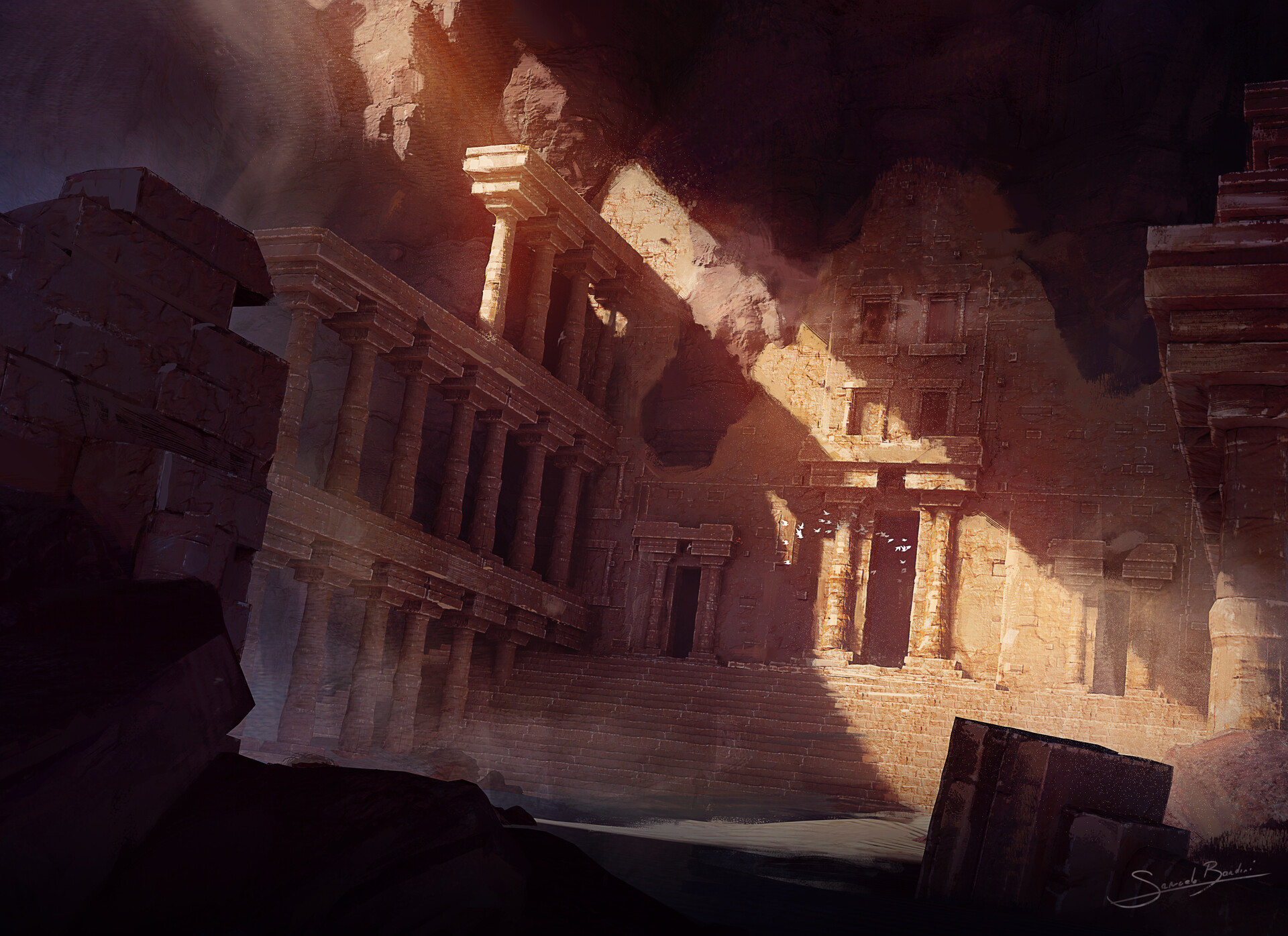
I'm helping to playtest SquigBoss's Seas of Sand campaign setting, which is vaguely North African, so I made an oil refiner like the boys rolled with in the Islamic Golden Age to wreak some havoc.
Kerosene Refiner
Start with an alembic, fireproof gloves, a bellows-powered spray nozzle, two flasks of crude oil, and some leathery scars.
A: Distiller, Smoke Squint
B: Appeasement, Soot Lungs
C: Alchemy, Smouldering Scars
D: Chug, Inferno Gate
(A) Distiller: You can distill crude oil into kerosene or petroleum jelly, and spray liquids around using your nozzle.
It takes a night or a day to distill [template]+1 flasks of oil or jelly, provided you have an equivalent amount of crude.
Your nozzle is two-handed, holds one flask of oil, and has a range of 30 feet. It gains +10 feet in range for every other template you take in this class, and at Template C it holds another flask of oil. It takes one action to spray your nozzle and one turn to reload it.
(A) Smoke Squint: You can see through fire and smoke like clear water.
(B) Appeasement: You can convince a fire to stop provided you throw something valuable into it immediately. A gold piece/dash of water for a campfire, fistfuls of bling/food animals/barrel of water for a bonfire, and literal crowns/people/shipload of water/artifacts for a city block eating inferno.
(B) Soot Lungs: You can breathe in smoke normally.
(C) Alchemy: You can refine most liquids into a flammable substance.
(C) Smouldering Scars: If you mortify a body part in fire, like a hand or calf or face, you can carry fire on that skin without burning. Lose 1 HP permanently for every part you mortify.
(D) Chug: You can drink a pitcher of something flammable without any ill effects and spray it up to a day later.
(D) Inferno Gate: Step through fires you set like doorways.
Short and sweet. This is perhaps one of my favorite GLOG classes I've ever made.
Showing posts with label Usable. Show all posts
Showing posts with label Usable. Show all posts
Wednesday, July 15, 2020

Friday, May 8, 2020
BONES: A GLOG HACK
Here's a skeletal GLOG ruleset. Please, enjoy the BONES.
Click the skull for a PDF!
Features
- 4d4 stat generation for 3 stats
- No modifiers or derived stats
- Stats as inventories
- Simple rules for drugs, diseases, and friends/enemies.
- Systems and items affecting each stat inventory to create pressure for space
- Stress-relief enemas
- And more!
Here's the Google Docs link for an evolving version.
Why These Rules
The following is reproduced at the bottom of these BONES, but in case you don't want to scroll down all that way, here you go:
I reduced the stats to inventories. That’s what a character is, when you pare away the derived numbers - a list of traits that make them an individual. Your PC isn’t defined by their Intelligence and Wisdom. They’re defined by what they know and how they use it, and that information can’t be reduced to a number disassociated from the concepts that define them. Bones PC’s may seem more complex than other OSR systems, but I’d like to argue that I’m simply increasing the information density of a character. The goal is to have all the items inside the stat pissing out.
Part of the 6-stat orthodoxy is the diffusion of power across stats to avoid any one becoming too good. The risk of imbalance is greater with less stats, but I want my stats more impactful as opposed to struggling to find a purpose for certain stats outside niche class features.
I also included rules for friends because of the weird paradox inherent in dungeoncrawling, where you trust someone to save your life but are careful to not form a lasting attachment because they might die. I say bollocks to that. If y’all’re playing this game together y’all’re probably going to become friends anyway. No need to assume your PC’s are emotionally distant robots. Care for each other. I think the game becomes richer with that kind of investment.
I don’t like numbers. Fiddly +1 to X, -1 to X - yes, it arouses the pattern finder, but sums are the first thing defenestrated by memory in stressful situations. Does balancing systems of bonuses make the game more fun or are they simply fun to design? Depends on you and your players.
Does any of the philosophizing above really matter? I don’t know. If 3.5, 5e, or Mothership work for you, go for it. Play what makes you happy. But try to find out what doesn’t work, and make it better.
Have fun!
Wednesday, July 31, 2019
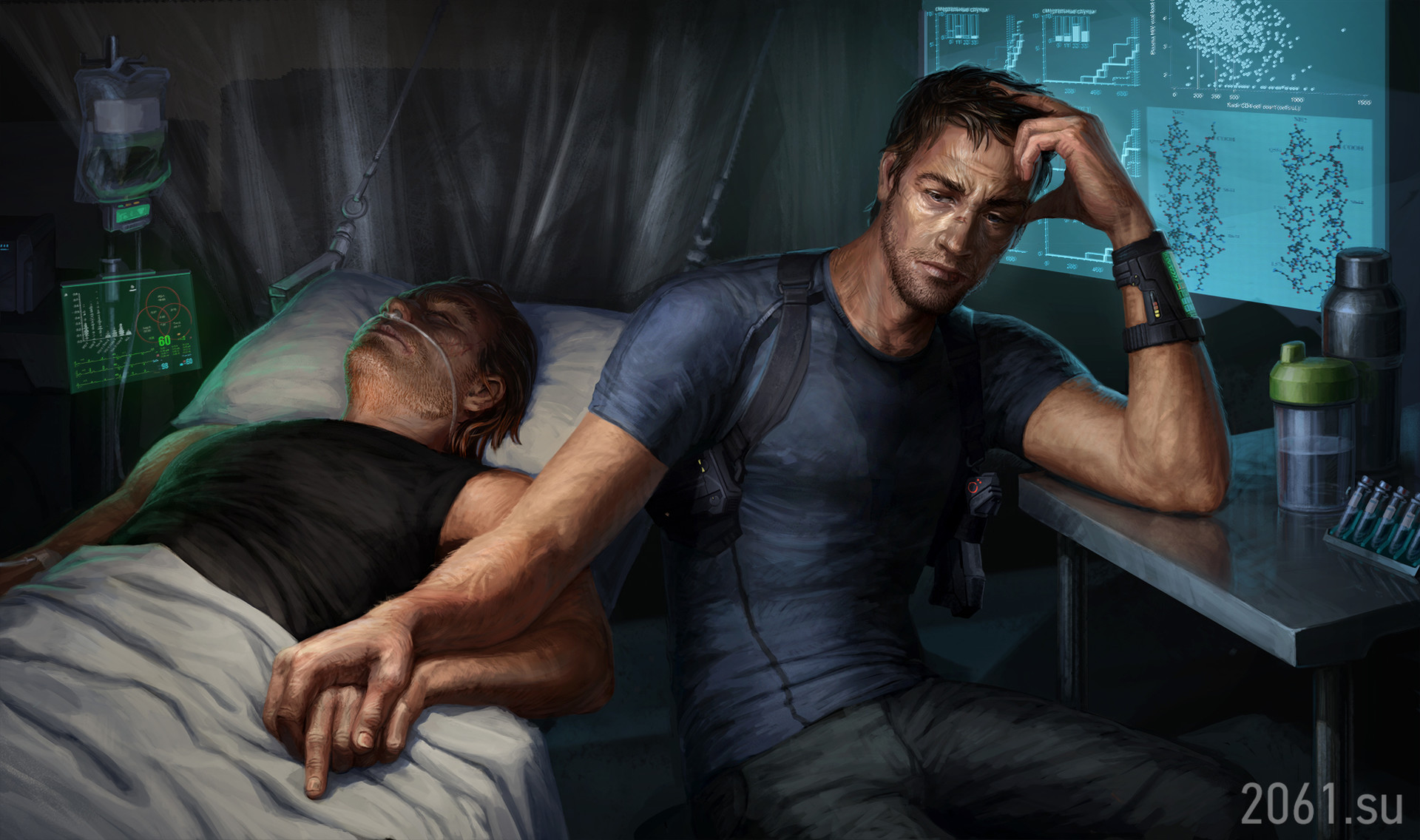
More Ways to Get Sick!
Base Rules:
When you contract a disease, whether from the environment, an enemy, or spoiled food, it infects a random slot of inventory (never a slot with mutations, usually a physical slot). Put a D by the infected slot. You know when you’re infected with something, just not what unless you've had that disease before.
Each interval, make a Constitution save or the number of slots that disease takes up doubles (eg: 1->2->4->8), infecting random slots not infected with the same disease. If the disease ever infects an inventory slot that has something in it, you suffer its Symptoms, and if it infects all your slots without killing you, you must Save vs Con or die unless otherwise specified. If you’re infected by more than one disease, use the symptoms for the worse one.
You can stave off the worst effects of a disease, its spread, or even reverse the progress of some diseases by giving in to the disease’s Urges. (You don't have to follow a disease's Urge, you'll just want to.)
If the disease can be reversed, you can make a Con save to reverse it one Interval after you've succeeded on a Con save to stop its spread.
Some diseases are infectious. Some are not. Infectious diseases are spread by close proximity (3 in 6 chance per day), by combat (2 in 6, 4 in 6 if you killed a diseased creature) and are always spread by contact.
Diseases can be cured by magic, medicine, downtime, and very rarely exorcism. Some of them have no cure.
This post pairs deliciously, like fine cheese and wine - no, more like blood and mosquitoes - with Lexi's Plaguezerker, as part of a sick collaboration! Disease names also courtesy of Lexi!
Diseases (d20):
1. The Plague (Interval: Daily, Inventory: Physical, Infectious)
Symptoms: Large black buboes, chills, weakness,, and gangrene of the extremities. Save vs Con with a penalty equal to the number of slots infected or die in 1d4 days.
2. Malaria (Interval: Weekly, Inventory: Physical, Infections)
Symptoms: Fever, Save vs Con when you eat or vomit up food, Save vs Con after intense exertion or have muscle spasms.
3. Smallpox (Interval: Daily, Inventory: Physical, Infectious)
Symptoms: High fever, pustules all over the body, hard coughing. Save vs Con or die in 2d4 days.
4. Leprosy (Interval: Weekly, Inventory: Physical)
Symptoms: Gradual numbness in affected areas, skin rash. Save vs Con or lose 1d4 digits, exploding on a 4. If you’re out of digits, you start losing limbs. Does not kill.
5. Rabies (Interval: Weekly, Inventory: Physical)
Symptoms: No immediate symptoms. Save vs Con or die in 1d4 weeks. A week before death, you become murderously aggressive, infectious, and develop a fear of water, refusing to drink.
6. Cholera (Interval: Exploration Turn, Inventory: Physical, Infectious)
Symptoms: Immediate, unstoppable diarrhea. If you can’t get clean water, you die in 1d4 hours. Reversible.
Urge: Drink water and rest to avoid getting sicker. 2 rations worth of water an hour to prevent the spread, 4 rations of water an hour allows you to make Con saves to reverse the spread with advantage.
7. Influenza (Interval: Daily, Inventory: Physical, Infectious)
Symptoms: Fever, chills, soreness, fatigue, sneezing, runny nose. Reversable.
Urge: Rest to avoid getting sicker. If you rest uninterrupted for 1d4 days, you may make Con saves to reverse the spread with advantage.
8. Tuberculosis (Interval: Weekly, Inventory: Physical)
Symptoms: Roll a d10 every Interval. On a 1, you become infectious, die in 1d4 weeks, and until then, you cough bloody phlegm.
9. Ebola (Interval: Daily, Inventory: Physical, Infectious)
Symptoms: Exactly like influenza. Save vs Con or die in 1d8 days, bleeding heavily from your orifices in the last day.
10. Prions (Interval: Monthly, Inventory: Flip a coin. Mental on heads, Physical on tails.)
Symptoms: 1d6 random symptoms. (see table below) Save vs Death or die in 1d4 weeks.
11. Mummy Rot (Interval: Daily, Inventory: Physical)
Symptoms: Skin darkens and peels away in papery strips. Dust falls from joints. Save vs Con or lose 1 limb a day until you die.
Urge: Obey a mummy’s direct orders.
12. Cordyceps (Interval: Daily, Inventory: Physical, Infectious)
Symptoms: A fungal growth begins to emerge from a random facial orifice, growing upwards. Save vs Con or die in 1d4 hours.
Urge: Find large gatherings of people. Take dead flesh and stack it into spiraling piles and twisted lines. Babble.
13. Contagious Murder (Interval: Daily, Inventory: Mental, Infectious)
Symptoms: You begin envisioning your comrade’s most likely form of death in the next day. Save vs Will or kill them, spreading the disease to all who witness you kill them.
14. Magepox (Interval: Daily, Inventory: Mental, Infectious)
Symptoms: Your skin begins to dry out and painfully separate into paper-thin layers very suitable to be torn off and written on. If you die, you collapse into a mess resembling a large pile of discolored paper.
Urge: Peel off your flaking skin. Anyone who touches the skin or reads what you write on it must Save vs Con or contract Magepox.
15. Goblin Plague (Interval: Exploration Turn, Inventory: Physical, Infectious)
Symptoms: Goblins are drawn to you, 1 goblin for every slot infected. If you’re a goblin, look over here. Not lethal.
16. Red Death (Interval: Minute, Inventory: Physical, Infectious)
Symptoms: You bleed from all orifices for 1 damage per slot infected/combat round. Incredibly lethal, incredibly rare. Almost never natural.
17. Vampirism (Interval: Daily, Inventory: Physical, Infectious)
Symptoms: You take 1d4 damage when exposed to sunlight per combat round, silver and consecrated weapons deal critical damage to you, you cast no shadow and no reflection, and you can turn into a small rat, bat, or toad. You can eat anything but can only survive off blood. 1 regular person has 4 rations of blood in them. If someone gives you permission to feed, you can do it without infecting them for 1d4 damage. This disease does not kill you.
Urge: Drink blood whenever possible. If you ever take this blood without asking, you can turn into a wolf and merge with darkness, but you can no longer cross running water or enter a home without being invited in.
18. Eyeball Spores (Interval: Daily, Inventory: Mental)
Symptoms: Your eyeballs slowly divide like cells. (1 division/day) This is incredibly painful and gives you a cumulative -1 to anything involving sight for every eyeball that buds off you. These eyeballs have small tentacles to crawl away and will eventually grow into beholders with a strange tolerance for you. This disease is not lethal.
19. Sanity (Interval: Daily, Inventory: Both)
Symptoms: You gradually begin to hear the words of people playing a game. It’s easy enough to ignore, but what they’re talking about is eerily similar to whatever you’re doing, and listening to them automatically progresses the disease one stage but allows you to get insights into the world. When you’re fully infected, Save vs Will. If you fail, you go stark raving mad. If you succeed, you become an NPC who’s conveniently forgotten what they heard.
20. Goldipox (Interval: Weekly, Inventory: Physical)
Symptoms: Any money on your person degrades one step: gold to silver, silver to copper, copper to dirt. Offloading degraded money onto others infects them.
Urge: Get your hands on as much money as possible. If you ever collect 1000 gold coins or one flawless diamond, those items turn into dirt, but you’re cured.
Random Symptoms (d20):
1. Fever
2. Chills
3. Shaking
4. Uncontrollable laughter
5. Mild bleeding from orifices
6. Headache
7. Fatigue
8. Sneezing
9. Diarrhea
10. Vomiting
11. Sore throat
12. Compulsion
13. Phobia
14. Philia
15. Itching
16. Rash
17. Licking lips
18. Jaundice
19. Bruising
20. Weird pee
When you contract a disease, whether from the environment, an enemy, or spoiled food, it infects a random slot of inventory (never a slot with mutations, usually a physical slot). Put a D by the infected slot. You know when you’re infected with something, just not what unless you've had that disease before.
Each interval, make a Constitution save or the number of slots that disease takes up doubles (eg: 1->2->4->8), infecting random slots not infected with the same disease. If the disease ever infects an inventory slot that has something in it, you suffer its Symptoms, and if it infects all your slots without killing you, you must Save vs Con or die unless otherwise specified. If you’re infected by more than one disease, use the symptoms for the worse one.
You can stave off the worst effects of a disease, its spread, or even reverse the progress of some diseases by giving in to the disease’s Urges. (You don't have to follow a disease's Urge, you'll just want to.)
If the disease can be reversed, you can make a Con save to reverse it one Interval after you've succeeded on a Con save to stop its spread.
Some diseases are infectious. Some are not. Infectious diseases are spread by close proximity (3 in 6 chance per day), by combat (2 in 6, 4 in 6 if you killed a diseased creature) and are always spread by contact.
Diseases can be cured by magic, medicine, downtime, and very rarely exorcism. Some of them have no cure.
This post pairs deliciously, like fine cheese and wine - no, more like blood and mosquitoes - with Lexi's Plaguezerker, as part of a sick collaboration! Disease names also courtesy of Lexi!
 |
| Katerina Kirillova |
Diseases (d20):
1. The Plague (Interval: Daily, Inventory: Physical, Infectious)
Symptoms: Large black buboes, chills, weakness,, and gangrene of the extremities. Save vs Con with a penalty equal to the number of slots infected or die in 1d4 days.
2. Malaria (Interval: Weekly, Inventory: Physical, Infections)
Symptoms: Fever, Save vs Con when you eat or vomit up food, Save vs Con after intense exertion or have muscle spasms.
3. Smallpox (Interval: Daily, Inventory: Physical, Infectious)
Symptoms: High fever, pustules all over the body, hard coughing. Save vs Con or die in 2d4 days.
4. Leprosy (Interval: Weekly, Inventory: Physical)
Symptoms: Gradual numbness in affected areas, skin rash. Save vs Con or lose 1d4 digits, exploding on a 4. If you’re out of digits, you start losing limbs. Does not kill.
5. Rabies (Interval: Weekly, Inventory: Physical)
Symptoms: No immediate symptoms. Save vs Con or die in 1d4 weeks. A week before death, you become murderously aggressive, infectious, and develop a fear of water, refusing to drink.
6. Cholera (Interval: Exploration Turn, Inventory: Physical, Infectious)
Symptoms: Immediate, unstoppable diarrhea. If you can’t get clean water, you die in 1d4 hours. Reversible.
Urge: Drink water and rest to avoid getting sicker. 2 rations worth of water an hour to prevent the spread, 4 rations of water an hour allows you to make Con saves to reverse the spread with advantage.
7. Influenza (Interval: Daily, Inventory: Physical, Infectious)
Symptoms: Fever, chills, soreness, fatigue, sneezing, runny nose. Reversable.
Urge: Rest to avoid getting sicker. If you rest uninterrupted for 1d4 days, you may make Con saves to reverse the spread with advantage.
8. Tuberculosis (Interval: Weekly, Inventory: Physical)
Symptoms: Roll a d10 every Interval. On a 1, you become infectious, die in 1d4 weeks, and until then, you cough bloody phlegm.
9. Ebola (Interval: Daily, Inventory: Physical, Infectious)
Symptoms: Exactly like influenza. Save vs Con or die in 1d8 days, bleeding heavily from your orifices in the last day.
10. Prions (Interval: Monthly, Inventory: Flip a coin. Mental on heads, Physical on tails.)
Symptoms: 1d6 random symptoms. (see table below) Save vs Death or die in 1d4 weeks.
11. Mummy Rot (Interval: Daily, Inventory: Physical)
Symptoms: Skin darkens and peels away in papery strips. Dust falls from joints. Save vs Con or lose 1 limb a day until you die.
Urge: Obey a mummy’s direct orders.
12. Cordyceps (Interval: Daily, Inventory: Physical, Infectious)
Symptoms: A fungal growth begins to emerge from a random facial orifice, growing upwards. Save vs Con or die in 1d4 hours.
Urge: Find large gatherings of people. Take dead flesh and stack it into spiraling piles and twisted lines. Babble.
13. Contagious Murder (Interval: Daily, Inventory: Mental, Infectious)
Symptoms: You begin envisioning your comrade’s most likely form of death in the next day. Save vs Will or kill them, spreading the disease to all who witness you kill them.
14. Magepox (Interval: Daily, Inventory: Mental, Infectious)
Symptoms: Your skin begins to dry out and painfully separate into paper-thin layers very suitable to be torn off and written on. If you die, you collapse into a mess resembling a large pile of discolored paper.
Urge: Peel off your flaking skin. Anyone who touches the skin or reads what you write on it must Save vs Con or contract Magepox.
15. Goblin Plague (Interval: Exploration Turn, Inventory: Physical, Infectious)
Symptoms: Goblins are drawn to you, 1 goblin for every slot infected. If you’re a goblin, look over here. Not lethal.
16. Red Death (Interval: Minute, Inventory: Physical, Infectious)
Symptoms: You bleed from all orifices for 1 damage per slot infected/combat round. Incredibly lethal, incredibly rare. Almost never natural.
17. Vampirism (Interval: Daily, Inventory: Physical, Infectious)
Symptoms: You take 1d4 damage when exposed to sunlight per combat round, silver and consecrated weapons deal critical damage to you, you cast no shadow and no reflection, and you can turn into a small rat, bat, or toad. You can eat anything but can only survive off blood. 1 regular person has 4 rations of blood in them. If someone gives you permission to feed, you can do it without infecting them for 1d4 damage. This disease does not kill you.
Urge: Drink blood whenever possible. If you ever take this blood without asking, you can turn into a wolf and merge with darkness, but you can no longer cross running water or enter a home without being invited in.
18. Eyeball Spores (Interval: Daily, Inventory: Mental)
Symptoms: Your eyeballs slowly divide like cells. (1 division/day) This is incredibly painful and gives you a cumulative -1 to anything involving sight for every eyeball that buds off you. These eyeballs have small tentacles to crawl away and will eventually grow into beholders with a strange tolerance for you. This disease is not lethal.
19. Sanity (Interval: Daily, Inventory: Both)
Symptoms: You gradually begin to hear the words of people playing a game. It’s easy enough to ignore, but what they’re talking about is eerily similar to whatever you’re doing, and listening to them automatically progresses the disease one stage but allows you to get insights into the world. When you’re fully infected, Save vs Will. If you fail, you go stark raving mad. If you succeed, you become an NPC who’s conveniently forgotten what they heard.
20. Goldipox (Interval: Weekly, Inventory: Physical)
Symptoms: Any money on your person degrades one step: gold to silver, silver to copper, copper to dirt. Offloading degraded money onto others infects them.
Urge: Get your hands on as much money as possible. If you ever collect 1000 gold coins or one flawless diamond, those items turn into dirt, but you’re cured.
 |
| Monica Delgado |
Random Symptoms (d20):
1. Fever
2. Chills
3. Shaking
4. Uncontrollable laughter
5. Mild bleeding from orifices
6. Headache
7. Fatigue
8. Sneezing
9. Diarrhea
10. Vomiting
11. Sore throat
12. Compulsion
13. Phobia
14. Philia
15. Itching
16. Rash
17. Licking lips
18. Jaundice
19. Bruising
20. Weird pee
Design Notes:
Three goals here. One was to create impactful rules, which is why the common cold isn't on this list, and why the duration for almost all of these diseases is daily. The duration between "getting worse" is geared towards a party crawling through a dungeon or hexcrawling through the wilderness. Obviously, with campaigns that have longer time measurements, (e.g: if one day was one exploration turn) these diseases are more lethal. Feel free to scale anything about the effects and durations that you want, that's supposed to be flexible.
Another goal was to bolt disease onto an already existing system instead of creating a completely disassociated system. By linking disease to physical inventory, I'm trying to create another reason to track inventory. If carrying all that loot makes you sicker, (or at least feel the effects of your sickness) will you chance it, or will you dump it in exchange for survival?
Another goal was to do disease without linking it to ability score damage. I suppose it's because players are bad at keeping track of penalties, but the same argument can be made against my system. I'd like to argue that having disease as a concrete inventory "infection" instead of "you have syphilis, make 1 save a day" places it more in the players minds. If you have a high score, are you really going to miss one or two points? Well, yes, but only in situations where those points could've made a difference. Unless a disease does a lot of ability score damage, sometimes its effects can be easy to forget when you have to keep track of loot, hirelings, light, spells, HP, and other party members! But if disease is directly linked to loot, which is gold, which is XP, then your players have a reason to care.
I also think that different symptoms help differentiate a disease in a way more interesting than math.
The inventory argument only holds up as long as inventory matters, which I think it should. If you run games without good inventory systems (5e comes to mind) or don't like inventory (which is fine) ability score damage may work better for you. But for a more OSR mindset, where what you're carrying and how much you can carry matters, I think disease should be tangible, infectious, and scary.
Disease also gives some weight to downtime. Most players use it to recover from wounds, buy things/gain XP from spending money, and the like. But having disease recovery as a viable option gives downtime a bit more purpose, even if that purpose is just removing a negative condition.
Don't forget to infect hirelings and pack animals too. Animals are plague vectors.
This also gives a different cast to things that remove disease or cure all diseases. If progression is important to a mechanic, anything that instantly solves that mechanic, ignoring its usual progression, should be at least rare. I'd advise modifying spells that cure diseases into spells that give a saving throw to halt or reverse a disease's progression.
I considered including mechanics to cure disease in this post but most of those were either a long list of "X thing that requires money/exploration/time to find" or "here's another subsystem!" My recommendation is adapting any subsystem you have for preparing food to preparing cures. Just requires different ingredients. I'll probably write my own, but for now I wanted to focus on presenting a challenge. Y'all solve challenges in OSR games, right?
Friday, July 26, 2019
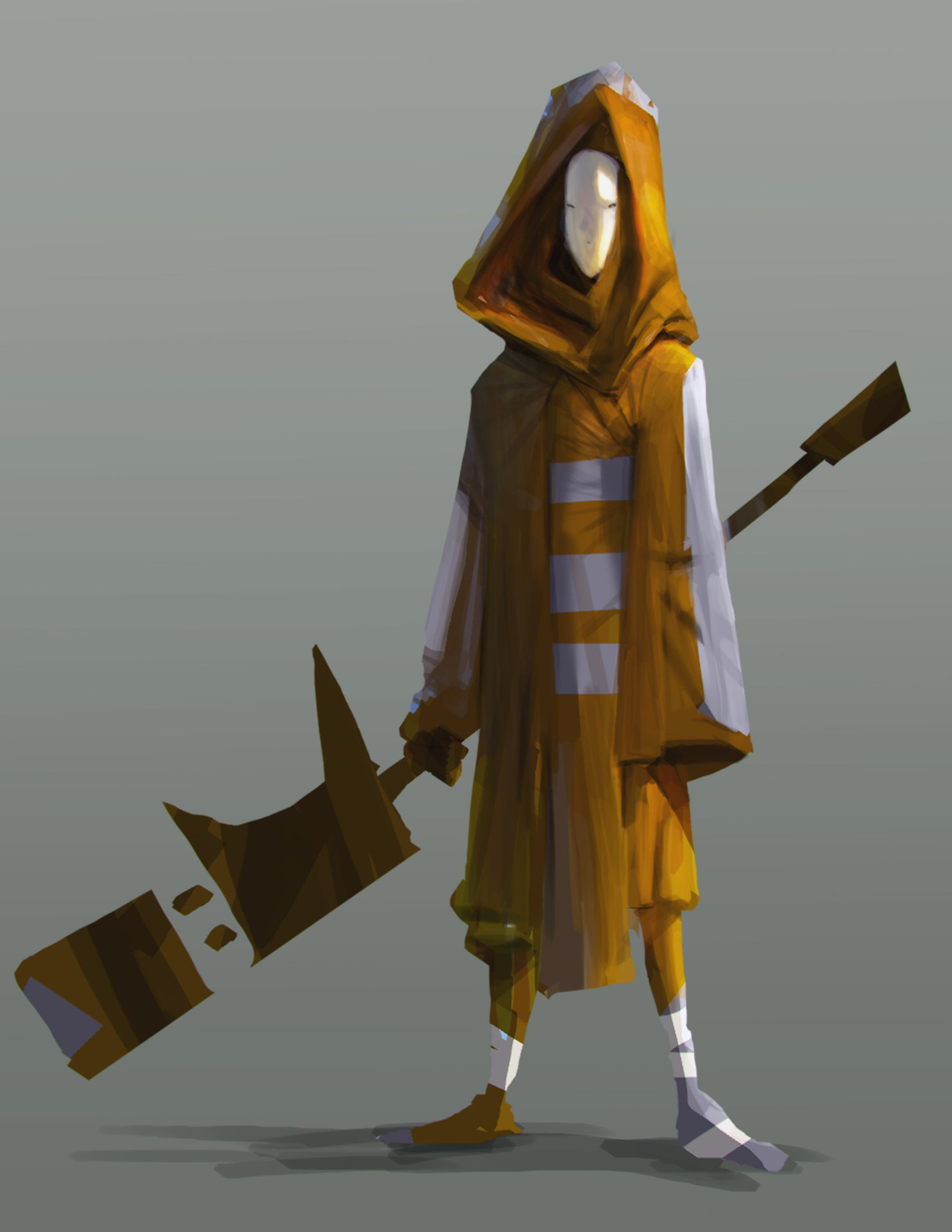
Warlock Patron: Tawantinsuyu Imperial Armories
By Inti and Inca Mancoti, you will bring light to these rich, fertile lands. Your light is glorious, blinding, and brief, but while it burns, how wondrous! Soldiers will fear the golden sun on your breast, shells and bullets will strike off you harmlessly, and you will wreak havoc.
Blind and blast! For Sun and Emperor!
Main warlock rules here. This warlock is dedicated to Lexi, as thanks for everything she's helped me with.
Starting equipment: A pair of darkened glasses, a beaten gold cup, a spyglass, and a quipu.
Boon: 5 in 6 chance to ignore damage from friendly fire. Self-damage does not count. If unsure, flip a coin. Occasionally, when you touch metal, it flashes.
Favors:
Convert ammunition types to different types - cartridges to bullets, artillery shells to bullets, etc - once a day. Can only do this for ammo you’ve used before.
Set off very flammable materials (oil, gunpowder, alcohol, dry tinder, etc) with a touch.
Dry and oil a metal object by running your hands over it.
Goals: Win conflicts for the holder of your contract, ideally the Tawantinsuyu Imperial Armories. Contract expires upon your permanent death or helping your contract holder to win 5 wars, whichever is sooner.
Obligations (1d8):
Kill 3 x [Debt] enemy creatures.
Assassinate [Debt] enemy commanders.
Ferret out [Debt] enemy agents.
Recover 2 x [Debt] taken weapons or equivalent objects.
Capture 3 x [Debt] war prisoners.
Destroy [Debt] enemy fortifications.
Rescue 2 x [Debt] captives.
Help [Debt] operatives infiltrate enemy territory.
Spells:
Sparks Off Cloaks
R: 0 T: [dice] creatures D: [sum]/target attacks
If an attack would damage you and it was faster than a thrown rock, step the damage dice down [dice] sizes. Step the damage dice of attacks slower than a thrown rock up [dice] sizes. If you cast this spell with 3 or more dice, you may reflect [dice] attacks faster than a thrown rock back at their origin.
Preundetonation
R: [dice] x 30’ T: explosive material D: [dice] rounds
With a gesture, you can either set off or defuse [dice] or less explosives that you can see. If you Test versus Dex, you can set off or defuse fast-moving explosives.
Ferrous Charmer
R: [dice] x 20’ T: ferrous metal D: [sum] rounds
You can attract or repel metal. See the table below for the size and speed of metal you can affect.
1 dice: Knife size at walking speed.
2 dice: Torso at running speed.
3 dice: Human running as fast as a horse.
4 dice: Cart blurring with motion. Can warp the paths of bullets.
Blast Wave
R: 200’ T: 20’ radius D: 0
Objects and people take [sum] damage. For every hard, immovable surface the blast wave overlaps, add [size] to the spell’s damage.
Shape Metal
R: touch T: metallic substance D: variable
You can mold refined metal that you touch like wet clay, sculpting it to your satisfaction. The changes last for [sum] rounds with 1 [dice], [sum] minutes with 2 [dice], [sum] hours with 3 [dice], and are permanent with 4 [dice].
Organs to Grenades
R: touch T: Fresh corpse with [dice] or less HD D: [sum] minutes
You convert [dice] organs of a fresh corpse (no older than [dice] days) into explosives. When you throw the meat nades, you may either set them to detonate on impact or detonate after [dice] or less rounds. Creatures in the radius of the explosives may Save vs Con for half damage.
.
Hand/foot: 1d4 damage, 10 ft. radius
Arm/leg: 2d4 damage, 20 ft. radius
Eye: 1 damage, 5 ft. Can see through the eyes of one damaged creature for the duration of the spell.
Ear: 1 damage, 5 ft. Can hear through the ears of one damaged creature for the duration.
Tongue: 1 damage, 5 ft, can talk with one damaged creature’s tongue for the duration.
Head: Deals 1d6 Stress damage, those who take full damage from the blast gain the contents of 1 random mental inventory slot from the head.
Sunlust
R: 100’ T: [dice] creatures D: [dice] minutes
Creatures you can see that can see sunlight must Save or rush towards it, staying in the sunlight for the duration of the spell. If 4 [dice] are invested, the duration is days instead of minutes. If there is no sunlight visible, the spell fails.
Blood to Gunpowder
R: touch T: unclotted blood D: permanent
You touch up to [dice] buckets of fresh blood from a creature with [dice] or less HD and convert it to dry gunpowder. If this blood is in an open wound, the creature must Save vs Con with advantage or take [sum] damage as its blood turns into gunpowder.
Metal to Light
R: touch T: metallic substance D: [dice] hours
As you hold some metal, you convert part of it to light. This subtracts half an inventory slot per hour from the metallic object. The brightness depends on the [dice] invested: 1 [dice] for a candle, 2 [dice] for a torch, 3 [dice] for a bonfire, and 4 [dice] for daylight brightness. Alternatively, if you cast this spell with 4 [dice], you may choose to instead turn light into metal.
Casting this spell with certain metals has different effects: gold produces sunlight, silver moonlight, mercury a poisonous grey light, occultum octarine light, etc.
Compartmentalize Mixture*
R: touch T: object D: 1hr
Command a mixture of items (a soup, a pile of coins) that weigh no more than [dice]x100lbs to separate into [sum]+1 categories. The separation is slow, and hindered by even the slightest effort. The categories must be clearly defined and identifiable by inspection. For example, you could split a soup into "vegetables" "broth" and "poison", or a pile of coins into "minted during the last century" and "older". You could not, however, split a pile of coins into "handled by Xerphion the Tyrant" and "not handled by Xerphion the Tyrant", as there's no way to tell just by inspecting them. You could not separate "a locked chest" and "its contents", because the items could not flow freely into separate piles.
Teleport to Shooter
R: self T: self D: 0
You may trigger this spell upon taking projectile or firearm damage from a creature trying to kill you. The damage from that attack is reduced by [dice] x 2 and you teleport to a safe spot within [dice] x 10’ of the attacking creature. If you can see your attacker, you can choose where you teleport to.
Solar Flare
R: self T: creatures D: [dice] rounds
Creatures that can see you must Save vs Dex or be blinded by a flash of sunlight.
Gaze of Inti
R: sight T: [dice] creatures in sunlight D: varies
When you cast this spell, roll all your Credit Dice, and note the time of day and the number of 4’s you roll, and consult the table below. If you roll four 4’s and you cast this spell at noon, for 4 rounds, you achieve perfection.
Morning:
Creatures lose [number of 4’s] levels of exhaustion.
Noon:
Creatures must Save vs Con. If they fail, they take [# of 4’s] x [dice] damage. If they pass, they gain [# of 4’s] MD that last as long as they stay in sunlight.
Afternoon:
Creatures lose up to [# of 4’s] x [dice] HP, which go to creatures of your choice. Save for half.
* - spell from Skerples's excellent List of 100 Orthodox Spells.
Patron’s Gift: If you are killed by an explosion you cause, note how many HD of sentient creatures (except yourself) were killed by that specific explosion. Then roll a d20. If you roll under the number of HD recorded, you return to life intact (if blown apart) and in the nearest safe location.
Design Notes:
These spells are pretty powerful, but also somewhat situational. Lots of them require objects or input to activate, and depending on your campaign world/technology level, not all of these spells are useful. For wizards running around a battlefield, though, any one of these spells could be a lifesaver...or could mean you die in a fiery explosion. Your obligations are also quite lethal.
My favorite spell that I’ve created here is perhaps Teleport to Shooter because of how many uses it has with foes and friends and how wrong it can go. Teleporting into a fortified enemy position with a bleeding wound is always a good idea.
Organs to Grenades sounds like so much fun - I really hope someone uses it soon.
I’m a bit worried about the thematic overlap of these spells - 3 of them have to do with metal, 2 projectiles, and 4 with explosive material (I’m including a favor). I don’t think this warlock is too narrow for my setting, but they certainly will be helpless in a social situation, which is what I intended.
Blind and blast! For Sun and Emperor!
Warlock Patron:
Tawantinsuyu Imperial Armories
 |
| Anthony Jones |
Main warlock rules here. This warlock is dedicated to Lexi, as thanks for everything she's helped me with.
Starting equipment: A pair of darkened glasses, a beaten gold cup, a spyglass, and a quipu.
Boon: 5 in 6 chance to ignore damage from friendly fire. Self-damage does not count. If unsure, flip a coin. Occasionally, when you touch metal, it flashes.
Favors:
Convert ammunition types to different types - cartridges to bullets, artillery shells to bullets, etc - once a day. Can only do this for ammo you’ve used before.
Set off very flammable materials (oil, gunpowder, alcohol, dry tinder, etc) with a touch.
Dry and oil a metal object by running your hands over it.
Goals: Win conflicts for the holder of your contract, ideally the Tawantinsuyu Imperial Armories. Contract expires upon your permanent death or helping your contract holder to win 5 wars, whichever is sooner.
Obligations (1d8):
Kill 3 x [Debt] enemy creatures.
Assassinate [Debt] enemy commanders.
Ferret out [Debt] enemy agents.
Recover 2 x [Debt] taken weapons or equivalent objects.
Capture 3 x [Debt] war prisoners.
Destroy [Debt] enemy fortifications.
Rescue 2 x [Debt] captives.
Help [Debt] operatives infiltrate enemy territory.
Spells:
Sparks Off Cloaks
R: 0 T: [dice] creatures D: [sum]/target attacks
If an attack would damage you and it was faster than a thrown rock, step the damage dice down [dice] sizes. Step the damage dice of attacks slower than a thrown rock up [dice] sizes. If you cast this spell with 3 or more dice, you may reflect [dice] attacks faster than a thrown rock back at their origin.
Preundetonation
R: [dice] x 30’ T: explosive material D: [dice] rounds
With a gesture, you can either set off or defuse [dice] or less explosives that you can see. If you Test versus Dex, you can set off or defuse fast-moving explosives.
Ferrous Charmer
R: [dice] x 20’ T: ferrous metal D: [sum] rounds
You can attract or repel metal. See the table below for the size and speed of metal you can affect.
1 dice: Knife size at walking speed.
2 dice: Torso at running speed.
3 dice: Human running as fast as a horse.
4 dice: Cart blurring with motion. Can warp the paths of bullets.
Blast Wave
R: 200’ T: 20’ radius D: 0
Objects and people take [sum] damage. For every hard, immovable surface the blast wave overlaps, add [size] to the spell’s damage.
Shape Metal
R: touch T: metallic substance D: variable
You can mold refined metal that you touch like wet clay, sculpting it to your satisfaction. The changes last for [sum] rounds with 1 [dice], [sum] minutes with 2 [dice], [sum] hours with 3 [dice], and are permanent with 4 [dice].
Organs to Grenades
R: touch T: Fresh corpse with [dice] or less HD D: [sum] minutes
You convert [dice] organs of a fresh corpse (no older than [dice] days) into explosives. When you throw the meat nades, you may either set them to detonate on impact or detonate after [dice] or less rounds. Creatures in the radius of the explosives may Save vs Con for half damage.
.
Hand/foot: 1d4 damage, 10 ft. radius
Arm/leg: 2d4 damage, 20 ft. radius
Eye: 1 damage, 5 ft. Can see through the eyes of one damaged creature for the duration of the spell.
Ear: 1 damage, 5 ft. Can hear through the ears of one damaged creature for the duration.
Tongue: 1 damage, 5 ft, can talk with one damaged creature’s tongue for the duration.
Head: Deals 1d6 Stress damage, those who take full damage from the blast gain the contents of 1 random mental inventory slot from the head.
Sunlust
R: 100’ T: [dice] creatures D: [dice] minutes
Creatures you can see that can see sunlight must Save or rush towards it, staying in the sunlight for the duration of the spell. If 4 [dice] are invested, the duration is days instead of minutes. If there is no sunlight visible, the spell fails.
Blood to Gunpowder
R: touch T: unclotted blood D: permanent
You touch up to [dice] buckets of fresh blood from a creature with [dice] or less HD and convert it to dry gunpowder. If this blood is in an open wound, the creature must Save vs Con with advantage or take [sum] damage as its blood turns into gunpowder.
Metal to Light
R: touch T: metallic substance D: [dice] hours
As you hold some metal, you convert part of it to light. This subtracts half an inventory slot per hour from the metallic object. The brightness depends on the [dice] invested: 1 [dice] for a candle, 2 [dice] for a torch, 3 [dice] for a bonfire, and 4 [dice] for daylight brightness. Alternatively, if you cast this spell with 4 [dice], you may choose to instead turn light into metal.
Casting this spell with certain metals has different effects: gold produces sunlight, silver moonlight, mercury a poisonous grey light, occultum octarine light, etc.
Compartmentalize Mixture*
R: touch T: object D: 1hr
Command a mixture of items (a soup, a pile of coins) that weigh no more than [dice]x100lbs to separate into [sum]+1 categories. The separation is slow, and hindered by even the slightest effort. The categories must be clearly defined and identifiable by inspection. For example, you could split a soup into "vegetables" "broth" and "poison", or a pile of coins into "minted during the last century" and "older". You could not, however, split a pile of coins into "handled by Xerphion the Tyrant" and "not handled by Xerphion the Tyrant", as there's no way to tell just by inspecting them. You could not separate "a locked chest" and "its contents", because the items could not flow freely into separate piles.
Teleport to Shooter
R: self T: self D: 0
You may trigger this spell upon taking projectile or firearm damage from a creature trying to kill you. The damage from that attack is reduced by [dice] x 2 and you teleport to a safe spot within [dice] x 10’ of the attacking creature. If you can see your attacker, you can choose where you teleport to.
Solar Flare
R: self T: creatures D: [dice] rounds
Creatures that can see you must Save vs Dex or be blinded by a flash of sunlight.
Gaze of Inti
R: sight T: [dice] creatures in sunlight D: varies
When you cast this spell, roll all your Credit Dice, and note the time of day and the number of 4’s you roll, and consult the table below. If you roll four 4’s and you cast this spell at noon, for 4 rounds, you achieve perfection.
Morning:
Creatures lose [number of 4’s] levels of exhaustion.
Noon:
Creatures must Save vs Con. If they fail, they take [# of 4’s] x [dice] damage. If they pass, they gain [# of 4’s] MD that last as long as they stay in sunlight.
Afternoon:
Creatures lose up to [# of 4’s] x [dice] HP, which go to creatures of your choice. Save for half.
* - spell from Skerples's excellent List of 100 Orthodox Spells.
Patron’s Gift: If you are killed by an explosion you cause, note how many HD of sentient creatures (except yourself) were killed by that specific explosion. Then roll a d20. If you roll under the number of HD recorded, you return to life intact (if blown apart) and in the nearest safe location.
Design Notes:
These spells are pretty powerful, but also somewhat situational. Lots of them require objects or input to activate, and depending on your campaign world/technology level, not all of these spells are useful. For wizards running around a battlefield, though, any one of these spells could be a lifesaver...or could mean you die in a fiery explosion. Your obligations are also quite lethal.
My favorite spell that I’ve created here is perhaps Teleport to Shooter because of how many uses it has with foes and friends and how wrong it can go. Teleporting into a fortified enemy position with a bleeding wound is always a good idea.
Organs to Grenades sounds like so much fun - I really hope someone uses it soon.
I’m a bit worried about the thematic overlap of these spells - 3 of them have to do with metal, 2 projectiles, and 4 with explosive material (I’m including a favor). I don’t think this warlock is too narrow for my setting, but they certainly will be helpless in a social situation, which is what I intended.
This is also the first warlock patron tailored to my setting!
Friday, July 5, 2019
P&P GLOG Class: Soldier
All my previous classes are part of my GLOG hack Plaster & Pulque, based off of preapocalyptic/postapocalyptic Victorian-era Mesoamerica where the Triple Alliance (Aztecs, main focus), Mayan city-states, and Tawantinsuyu (Incan empire) were never conquered or colonized. This is the first class that I feel reflects some specifics of the setting.
Some music to set the mood.
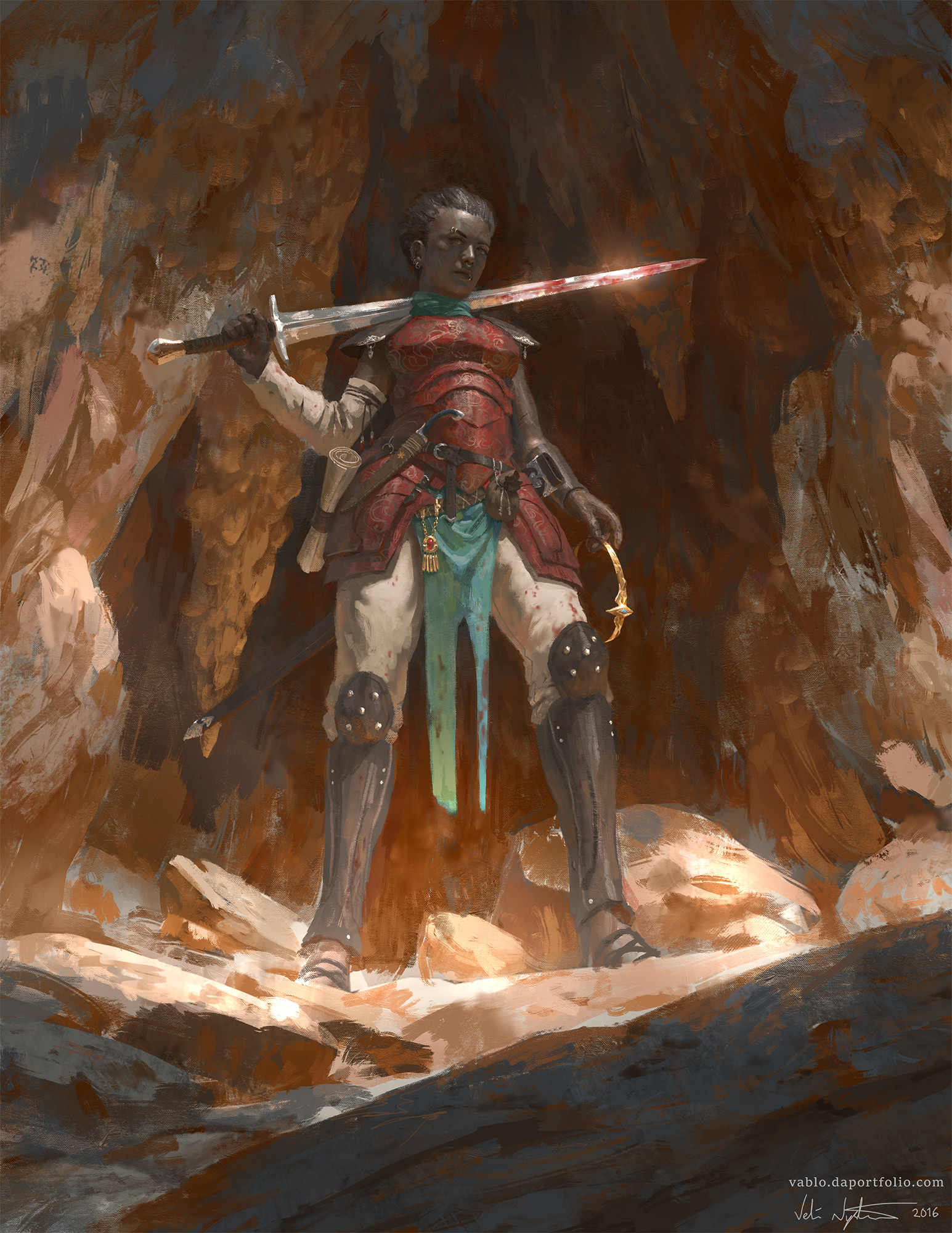
GLOG Class: Soldier
All glory to Lexi, Spwack, and Type1Ninja for reviewing this for me.
A: Barter, Ground Pounder, +1 Attack
B: Training or PFC, Connection, +1 Fighting Style
C: Specialist or Captain, Stoic, Mandate, + 1 Attack,
D: Special Forces or Sergeant, Requisition, +1 Fighting Style
Bartering is second nature to you. You can exchange luxury items (tequila ration, cacao bars/powdered cacao, pulque, tobacco) for other luxury items, rumors, gossip, privileged information, ammunition, drugs, and more instead of using regular currency. You can even trade with people whose language you don’t know or hostile soldiers if you’re a prisoner of war.
You’re a Ground Pounder. You can ignore up to Soldier [templates] of exhaustion from being encumbered, forced marches, or eating half rations. You can also stand 2 night watches without incurring exhaustion.
Exhaustion Sidebar: You gain exhaustion when undertaking strenuous physical activity without a break (usually a Con Save) or when you’re overencumbered. Each point of exhaustion takes up a slot of physical inventory that you choose without mutations, and if that slot is occupied, you have to get rid of whatever equipment is in that slot or take a cumulative -1 penalty to all rolls involving physical activities. If your number of exhaustion points takes up half your physical inventory, you must Save versus Con or collapse, unable to move until a point of exhaustion is removed.
A full meal and a good night’s sleep removes all exhaustion.
You’ve caught the attention of someone who wants you to get some Training, if you wish. You may choose or roll one option from the list below.
Training: (1d8)
- Combat Medic: As long as you have your medical satchel on hand, you may remove fatal wounds on a 3 in 6, halt the progress of fever, apply medication to prevent gangrene, and apply painkillers.
- Mechanic: With a toolkit and necessary materials, you can fix damaged or malfunctioning machines (including guns) that you’ve seen before, and if you don’t have the needed materials, you know what they are. You can repair unfamiliar machinery with a 2 in 6 chance. You can also sabotage machinery, creating faults undetectable to casual inspection.
- Loader: You can operate and tow a field gun, howitzer, mortar, or cannon along with 3 other people. You can submit a request for special ammunition and have an exquisite pair of binoculars, earplugs, and a rangefinder.
- Demolitionist: You can plant, set off, and defuse familiar explosives, and identify weak points in buildings and fortifications. You can defuse unfamiliar explosives with a 3 in 6. You have a small supply of blasting caps, safety fuses, and 6 sticks of dynamite or 6 gobs of blasting jelly.
- Field Engineer: You can direct the building of entrenchments and fortifications, divine rough floor plans of buildings you look at from 2 sides in 3 in 6, spot weaknesses/blind spots in fortifications, and create plans to remedy those blind spots. You have a scratchpad, charcoal, and a slide rule.
- Marksman: You have a scoped rifle that reduces penalties for aiming to 1/8th and one clip of sniper rounds along with a special uniform that helps you blend into either urban or jungle combat zones. You can sight for snipers, counter snipe, and divulge the directions of enemy movements or the possible locations of enemy commanders on 2 in 6. You can submit a request for special ammunition.
- Experimental: You’ve been assigned to test out experimental military technology/magic.
- Arcane: You’re given a rudimentary education in magic. Gain the cantrips and perk of a wizard school of your choice and the ability to detect combat magic like inverted goosebumps.
Experimental Technology (1d8):
- Flamethrowers
- Grenades (or special explosives)
- Guns (submachine guns, special ammunition, etc)
- Drugs (meth, regenerative, etc)
- Magical gear
- Enchantments
- Rubber gear or equipment
- Petroleum derivatives
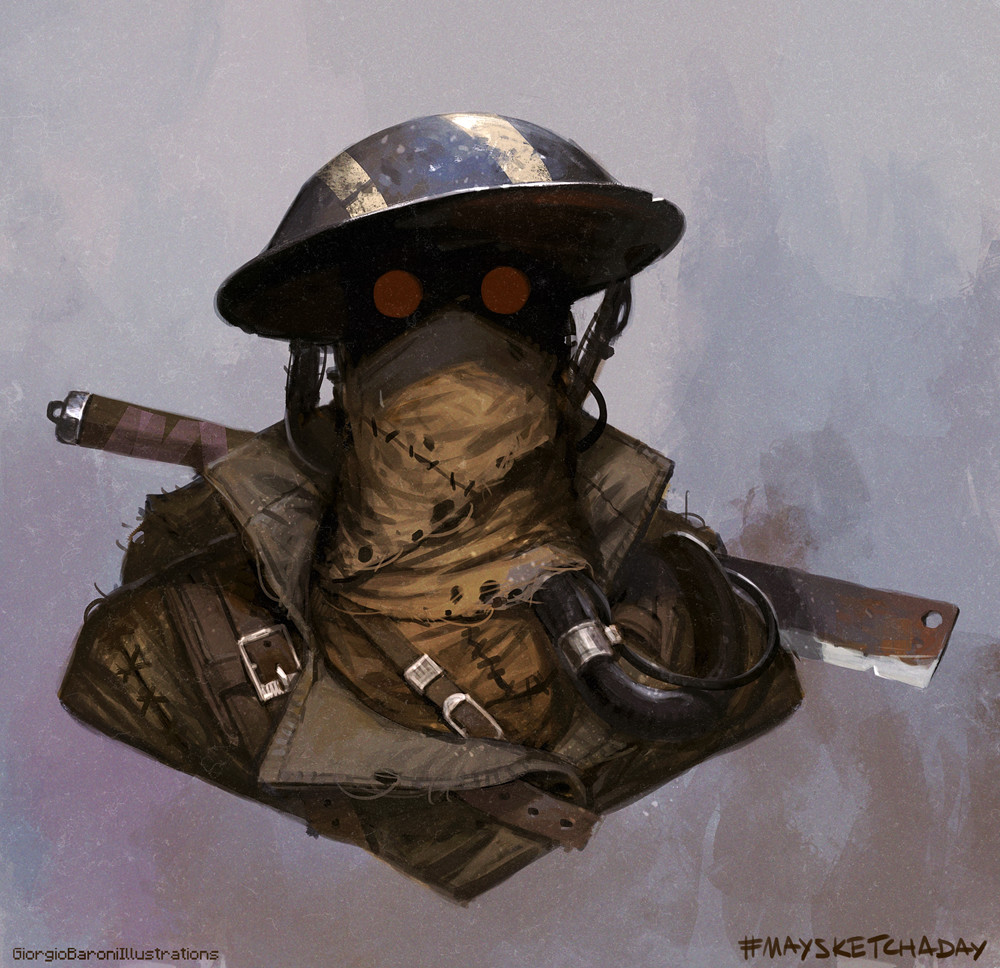
You’ve been promoted to a PFR (private first class, used liberally) and are put in charge of a 5-soldier unit, including yourself, that answers to a captain. You are responsible for your unit’s wellbeing and their behavior, and may give them orders that further your own and do not contradict or obfuscate any orders from higher ups except in extreme circumstances. Your soldiers will use hireling stats unless they’re other PC’s.
Despite your promotion, you don’t have to move any further up the command chain if you don’t want to.
You know a guy who knows a girl who has a Connection, enabling you to buy and sell contraband on black markets. Every time you buy or sell something, make a black mark and roll a d20. If you roll equal to or under the number of black marks you have, military police will show up (almost always in disguise) and investigate. For every week that goes by without you transacting via your Connection, remove a mark gained from your Connection.
Choose a Fighting Style from Mimics and Miscreants. Choose well!
You’re now a Specialist! Improve your Training to the corresponding Specialty if you already have one, choose another Training if you don't want to improve yours, or choose one Training if you don't already have one. You retain all the previous features of your Training unless otherwise noted.
Specialist:
- Field Surgeon: You have 2 combat medics to assist you and a portable surgery. When you have access to your surgery and an assistant, you may do anything a combat medic would do, amputate infected limbs, treat severe burns, reattach severed limbs successfully with a 1 in 6, cure gangrenous wounds with a 3 in 6, and remove fatal wounds with a 4 in 6. You can submit a request to use/carry special drugs or substances.
- Technician: You can design and construct mechanical devices and divine the function of unfamiliar machines. You can sabotage a machine to break down at a time within a day of your choosing with a 4 in 6 and jury rig a broken machine for one use or 1d6 rounds. You have a mechanic to assist you.
- Artillerist: You can operate any sort of artillery with 2 other people and are in charge of your own artillery piece, to be used at your discretion while following orders. You can diagnose malfunctions in artillery and detect unseeable faults in your artillery piece and its ammunition, and have access to special ammunition. With trained loaders, you can repair a damaged artillery piece with 2 in 6.
- Demolitions Expert: You oversee the destruction of strategic buildings and fortifications, infrastructure, and sapping efforts. You have 3 demolitionists under your command. You can also estimate the integrity of a damaged building and any weakened parts. You can also detect evidence of sapping operations, direct counter-sapping efforts.
- Engineer: You can plan and construct fortifications, buildings, and infrastructure. Additionally, you can identify hidden redoubts, bunkers, and artillery pieces. You have a field engineer to assist you.
- Sniper: You gain access to a sniper rifle and can manufacture a ghillie suit (camouflage suit) from surrounding materials while out of combat. You can acquire special ammunition.
- Experimental: You’ve survived testing the new innovation; it’s now yours to keep barring significant misconduct. Choose another thing to test!
- Arcane: You gain the drawback of the wizard school you chose, 1 MD, and 2 spells from that school. You can activate wizard vision in a 2 in 6 for one turn.
If you were a PFC or performed an extraordinary feat, you’re promoted to Captain to oversee a team of 20 soldiers: 3 PFC’s, 12 accompanying soldiers, and 5 specializing soldiers to be distributed among your forces as you see fit. You may give your forces orders that further your own.
If you take this feature but don’t have the PFC requisite, you gain the PFC feature instead.
You're Stoic, and can ignore one compulsion, phobia, and the like resulting from insanities while in an active combat zone. If you’re using this feature, Save versus Will with disadvantage after leaving an active combat zone or immediately suffer a breakdown.
You're Stoic, and can ignore one compulsion, phobia, and the like resulting from insanities while in an active combat zone. If you’re using this feature, Save versus Will with disadvantage after leaving an active combat zone or immediately suffer a breakdown.
You’re given a Mandate: permission to carry out your orders and preserve the lives of your forces as you see fit. For every time you publicly violate official regulations, disobey orders from higher-ups, or the like, make a black mark and roll a d6. If the d6 is equal to or less than the numbers of marks, your actions are subjected to review and you will be disciplined. If you ever acquire more than 6 black marks, you are subjected to discipline at the earliest possible opportunity.
Disciplinary Results: (1d6, 1d6 + black marks if you’ve acquired more than 6 black marks, including marks from your Connection.)
- 1 black mark. Keep track of these.
- 2 black marks.
- Demotion one rank (Sergeant → Captain, Specialist → Trained, etc. Please note that you don’t lose skills, just equipment and privileges. If you have rank and a Training/Specialty, you lose rank first.)
- Demotion one rank and 1 week of menial labor.
- Demotion two ranks.
- Demotion one rank and imprisonment for 1d4 weeks.
- Demotion one rank and 2d4 weeks spent doing menial labor around the camp.
- Demotion two ranks and assigned to a non-combat position (cook, janitor, etc) for 1d6 months.
- Demotion to private.
- Dishonorable discharge. Lose everything except your skills.
- No punishment. Instead, a powerful figure will handwave your punishment and try to blackmail you into aiding their scheme.
- Imprisonment for 2d20 20-day months (or 2d12 months if your campaign uses a more Gregorian calendar). Time to plot an escape, prove innocence, or try another character.
- (13 and up.) The death penalty, to be carried out in 1d4 days. Escape or last-minute stays are never impossible.
 |
| Ryan Meinerding |
You’re offered a chance to join a Special Forces team that operates on special assignments alongside friendly forces or alone. Upgrade a Training to a Specialty or choose another Training. You can choose a Soldier with 2 or more soldier templates to accompany you and gain access to special equipment to use on all your missions.
If you were previously a Captain, you’re promoted to Sergeant to oversee 4 captains with all their soldiers and either 4 specialists or 4 auxiliaries of your choice. If you were a PFC and took this feature, you become a Captain.
Auxiliary Forces:
- Sanctioned warlocks or wizards (Combat Mages)
- Sanctioned believers (Zealots)
- Sorcerer
- Sanctioned berzerkers
- Assassin
- Artillerist
- Prisoners of war fighting because you’re keeping loved ones hostage
- Mercenaries (can really be anything)
In the course of your mission, you may temporarily Requisition soldiers or materiel from lower ranking commanders.
Special ammunition for artillery/guns will be detailed in a separate post along with more complete encumberment/exhaustion/inventory/gun/artillery/etc rules.
Design Notes:
I’ve tried to create a class with a lot of career flexibility - one could either advance up the chain of command, improve individual capabilities and operate on a smaller tactical scale, or a little bit of both. The larger scale domain play (becoming a PFC, captain, and sergeant) requires more abstracted rules for combat to avoid lots of individual nitty-gritty dice rolls; probably lite wargame rules that work on at least 4 scales - individual (sniper duels!), PFC, captain, sergeant, and potentially higher.
This class is designed for maximum replayability. A captain with demolitionist training should feel and play very differently than a sniper with arcane training on a special forces team. Ideally, an entire party composed of soldiers would have a great time, while still feeling distinct from a group of thieves and wizards.
My hack doesn't have a class triad, but the Soldier is one of my Fighter analogues, along with my Veteran. I think there should be oodles of options for Fighterlike classes, to prevent the most interesting point of the class becoming "which weapon should I choose?"
My hack doesn't have a class triad, but the Soldier is one of my Fighter analogues, along with my Veteran. I think there should be oodles of options for Fighterlike classes, to prevent the most interesting point of the class becoming "which weapon should I choose?"
Wednesday, May 22, 2019
GLOG Class: Thief
You grew up lacking something. Parents, a home, a conscience, something to do, restraint. Any or all of those.
There’s no hole inside you. And even if there were, you’ve filled it with excitement.
Right?
GLOG Class: Thief
Changelog: 6/2: Added examples to an Eye for Detail.
A:The Heist*, Hidden Pockets, Fast Hands (Syndicate vs. Freelancer)^
B: Eye for Detail, Wall Crawling**, Unlabeled Package*
C: Tricky**, Scrounge**
D: Great Escape*, Opportunist*
* are sourced from Skerples’s Thief.
** are sourced from Type1Ninja’s Thief.
^ not core feature but discussed below the core features.
The Heist is the core of your being, the thrill of the hunt. Once per adventure or dungeon or campaign arc, you can gain 10% bonus XP for any one valuable item you personally stole. It has to pass through your hands, or you have to be the one masterminding the theft. Unguarded or abandoned treasure does not count (unless there are traps). For example, a gem worth 1,000gp would give you 100 extra XP. If the bonus XP would cause you to gain a level, you instead gain the exact amount needed to gain the level.
You’ve got Hidden Pockets on your person. You can mark a number of items equal to your Thief templates hidden. Unless your apparel, body, and armor is very thoroughly searched, these items won’t be found. The items hidden must be small enough to fit in your mouth.
Your Fast Hands help keep you alive. You gain an extra Fast inventory slot for each Thief template you have.
Your Eye for Detail helps you find things others overlook. You can spot additional details when searching or peeking or gain insight into the meaning of a detail.
1d6 extra details:
Wall Crawling is a necessary habit. You climb just as well without climbing gear as with it, and if a climb would be impossible using gear, you can roll anyway.
In town, you may spend any amount of money to buy an Unlabeled Package. When the package is unwrapped, you declare what it contains, as long as the contents comprise the appropriate number of Inventory Slots, don’t cost more than you originally paid, and are available in town. You can put multiple items inside a large Unlabeled Package, including smaller Unlabeled Packages. You can have no more than two Unlabeled Packages at a time.
You’re a Tricky combatant, as such, you roll with advantage when attempting Stunts.
Scrounge for useful things. Once per session, when you dig through trash or refuse, you can get an item rolled on the starting item table.
Once per day, you can automatically pull off a Great Escape from something that is restraining you and that you could plausibly escape from. This includes grapples, lynchings, and awkward social situations, but not sealed coffins or forcecages.
Be an Opportunist! Take advantage of situational bonuses to (surprise, elevation, etc) to deal an additional +1d6 damage on a nonmagical attack, provided you hit.
Syndicates versus Freelancers:
I didn’t include this in the core thief but I do think it’s an important part of thievery, and I’ll be using it in my own personal game.
Syndicated thieves enjoy a certain amount of protection, patronage, and equipment in exchange for 30-60% of their earnings per month. These rates can be negotiated, of course. Syndicates also act as contractors for thievery and similar endeavors, providing a somewhat steady source of employment and fences for objects. If a thief is caught or seen, a syndicate can bribe officers, eliminate witnesses, extract thieves, destroy records, or other such things. This aid depends on how much the thief pays the syndicate and how useful the syndicate perceives the thief to be. Some jobs are smokework, and if a thief gets caught on a smokework job, they’re expected to off themselves or be eliminated.
Freelancing thieves enjoy none of these benefits but keep 100% of their earnings. They can potentially build their own network or even their own syndicate but must be wary of competition from other syndicates or thieves. If a freelancer is attracting contracts away from syndicates, they may face recruitment offers, have an assassin sent after them, or have a bounty put on their head.
Basically, it’s a safety net versus faster leveling. The existence of syndicates also depends on the level of civilization in your setting, too.
Design Notes:
Well, I don’t believe in class triads. I do believe in the importance of sneaky stealy classes though. The feature that aggrieves me the most is Eye for Detail.
I struggled between giving thieves a Second Chance to see things or disarm traps or more information via Eye for Detail. I opted for more information but that means something else important: if the thief gets more information, they have an edge. This is right and good. Fighters get more attacks, wizards get more spells that summon killer ramen.
However, I don’t think thieves shouldn’t have a monopoly on information. All the clues necessary to solve the puzzle (including traps and maybe negotiations) need to be available to a party regardless of the number of thieves or quality of thieves the party has. I’m not going to lock information behind a successful roll if the party has been scouting/researching appropriately.
What is the utility of Eye for Detail, then, if all the information should be theoretically present to a party of veterans or druids?
Well, I see two options. The first is additional details that aren’t necessary to solve the puzzle/trap/social interaction but provide additional context. The second is an understanding of what the details mean. I’m sure there are other ways to use this, and I hope your thieves discover more ways.
This class will have some cross-pollination with the Assassin and possibly the Inquisitor. All three (Thief, Assassin, Inquisitor) do rely on a certain amount of subterfuge to accomplish their goals. Those goals will likely be very different, though.
This class will be a part of Who Fights Monsters, my in progress GLOG hack.
There’s no hole inside you. And even if there were, you’ve filled it with excitement.
Right?
 |
| Mathieu Latour-Duhaime |
GLOG Class: Thief
A:The Heist*, Hidden Pockets, Fast Hands (Syndicate vs. Freelancer)^
B: Eye for Detail, Wall Crawling**, Unlabeled Package*
C: Tricky**, Scrounge**
D: Great Escape*, Opportunist*
* are sourced from Skerples’s Thief.
** are sourced from Type1Ninja’s Thief.
^ not core feature but discussed below the core features.
The Heist is the core of your being, the thrill of the hunt. Once per adventure or dungeon or campaign arc, you can gain 10% bonus XP for any one valuable item you personally stole. It has to pass through your hands, or you have to be the one masterminding the theft. Unguarded or abandoned treasure does not count (unless there are traps). For example, a gem worth 1,000gp would give you 100 extra XP. If the bonus XP would cause you to gain a level, you instead gain the exact amount needed to gain the level.
You’ve got Hidden Pockets on your person. You can mark a number of items equal to your Thief templates hidden. Unless your apparel, body, and armor is very thoroughly searched, these items won’t be found. The items hidden must be small enough to fit in your mouth.
Your Fast Hands help keep you alive. You gain an extra Fast inventory slot for each Thief template you have.
Your Eye for Detail helps you find things others overlook. You can spot additional details when searching or peeking or gain insight into the meaning of a detail.
1d6 extra details:
- Marks of recent activity involving item/area
- Item/area’s history
- Use of item/area
- Past users of item/area
- Traces of a substance (liquid, powder) on an item/area
- Item/area partway through an action
In town, you may spend any amount of money to buy an Unlabeled Package. When the package is unwrapped, you declare what it contains, as long as the contents comprise the appropriate number of Inventory Slots, don’t cost more than you originally paid, and are available in town. You can put multiple items inside a large Unlabeled Package, including smaller Unlabeled Packages. You can have no more than two Unlabeled Packages at a time.
You’re a Tricky combatant, as such, you roll with advantage when attempting Stunts.
Scrounge for useful things. Once per session, when you dig through trash or refuse, you can get an item rolled on the starting item table.
Once per day, you can automatically pull off a Great Escape from something that is restraining you and that you could plausibly escape from. This includes grapples, lynchings, and awkward social situations, but not sealed coffins or forcecages.
Be an Opportunist! Take advantage of situational bonuses to (surprise, elevation, etc) to deal an additional +1d6 damage on a nonmagical attack, provided you hit.
Syndicates versus Freelancers:
I didn’t include this in the core thief but I do think it’s an important part of thievery, and I’ll be using it in my own personal game.
Syndicated thieves enjoy a certain amount of protection, patronage, and equipment in exchange for 30-60% of their earnings per month. These rates can be negotiated, of course. Syndicates also act as contractors for thievery and similar endeavors, providing a somewhat steady source of employment and fences for objects. If a thief is caught or seen, a syndicate can bribe officers, eliminate witnesses, extract thieves, destroy records, or other such things. This aid depends on how much the thief pays the syndicate and how useful the syndicate perceives the thief to be. Some jobs are smokework, and if a thief gets caught on a smokework job, they’re expected to off themselves or be eliminated.
Freelancing thieves enjoy none of these benefits but keep 100% of their earnings. They can potentially build their own network or even their own syndicate but must be wary of competition from other syndicates or thieves. If a freelancer is attracting contracts away from syndicates, they may face recruitment offers, have an assassin sent after them, or have a bounty put on their head.
Basically, it’s a safety net versus faster leveling. The existence of syndicates also depends on the level of civilization in your setting, too.
Design Notes:
Well, I don’t believe in class triads. I do believe in the importance of sneaky stealy classes though. The feature that aggrieves me the most is Eye for Detail.
I struggled between giving thieves a Second Chance to see things or disarm traps or more information via Eye for Detail. I opted for more information but that means something else important: if the thief gets more information, they have an edge. This is right and good. Fighters get more attacks, wizards get more spells that summon killer ramen.
However, I don’t think thieves shouldn’t have a monopoly on information. All the clues necessary to solve the puzzle (including traps and maybe negotiations) need to be available to a party regardless of the number of thieves or quality of thieves the party has. I’m not going to lock information behind a successful roll if the party has been scouting/researching appropriately.
What is the utility of Eye for Detail, then, if all the information should be theoretically present to a party of veterans or druids?
Well, I see two options. The first is additional details that aren’t necessary to solve the puzzle/trap/social interaction but provide additional context. The second is an understanding of what the details mean. I’m sure there are other ways to use this, and I hope your thieves discover more ways.
This class will have some cross-pollination with the Assassin and possibly the Inquisitor. All three (Thief, Assassin, Inquisitor) do rely on a certain amount of subterfuge to accomplish their goals. Those goals will likely be very different, though.
This class will be a part of Who Fights Monsters, my in progress GLOG hack.
Subscribe to:
Posts (Atom)
10,000 Chambers of the Cnite King
Deep within the turgid reaches of the Samarkand Desert, a lone crag of withered sandstone presents a visage long scoured by time. Samuele B...