Monday, May 18, 2020

On Discord

In the diaspora following the twilight ages of Google+, my escape has been to Discord. I've tried MeWe, Reddit, but ultimately returned to Chris McDowall's little hub of RPG activity.

In short, MeWe was too sparsely populated when I was on there and everything on Reddit has a half-life. I like Discord - more than I liked G+, but I didn't engage on G+ much as I should've. Too young.

G+ was more suited to RPG discussions because of its largely sedate pace, comment chains, ease of community creation, and the social media framework that let you repost and +1 material, spreading it further across the OSR scene than posting in the #blogroll channel, hoping someone might bring it up in #links and discussion, and posting a link in the OSR subreddit.

Discord is a chat platform. It serves quite well as an incubator for new ideas and communities (assuming you check it regularly). RPG's are part math, which provides clarity and lends itself to answers, and part art, which provides as many or as few answers as you desire. Any platform that discusses RPG's has to accommodate terse back-and-forth and long conceptual discussions. Discord does the former with ease, but you have to work at a longer conversation.

These conversations fall into several rough patterns. All of this is apocryphal.

When a new take is posted (because nothing is original), two tragedies, one good thing, and one great thing happen.
  1. People comment and riff and the discussion eventually spirals off or dies out.
  2. Somebody else brings up a similar idea they had.
  3. People praise the new take.
  4. Somebody actually offers critical feedback. This is rare.
I have cherry-picked data to support my conclusions below. All these comments are, more or less, responses to the GLOG hack I had just posted in this channel 10 days ago.


Why do I care about these tragedies?

RPG's are, in my mind, closest to Art than anything else. This means they grow through critique. In Discord, two things hamper the unfolding of this critique. 

#1: The Tragedy of Telephone
The first is due to the nature of the medium. There's a tendency among us Discord users to surf the conversational wave, riffing snappy remarks over whatever just got said. It's like a game of telephone: very entertaining, but the focus usually ends up being on the last witty remark rather than what prompted the conversation. This can be frustrating, especially if you're looking for some feedback or even just praise for a document you've spent weeks on.

#2: The Tragedy of Convergent Evolution
In all art forms, there is a very keen sense of heritage, and RPG's are no different. Whenever someone brings up an idea, I'm driven (especially as an artist) to post an idea someone else wrote similar to theirs or my take on the same concept as a way to help them. This is not a bad instinct but it hampers RPG brainstorming in several ways.

RPG brainstorming works best in the moment, when everyone involved is throwing out their ideas in a form of psychological flow. It's amazing when you throw yourself into it. Posting someone else's take interrupts that, because it encourages other people to read someone else's ideas for inspiration, breaking part of the group out of the creative flow. We made a 1000+ mech name generator once in a couple hours. It was wild, and nobody questioned it or posted inspiration posts.

Also, remember that sense of heritage? Well, everyone tends to remember whose take on a specific concept was the first one, especially if that writer is prolific. Skerples' Rat on a Stick/Many Rats on Many Sticks get thrown around as example GLOG hacks for that reason.

Before I draw my next conclusion, I want to say: this is a hobby. None of us (well, very few of us) are professional RPG producers. All of us excel at some other task, but this is our creative outlet, and it's very hard to avoid comparing our work to others or to avoid feeling inferior to those who write more frequently and better than we do.

Because of all of these factors, when someone posts a new take, and it contains an idea I've had but not written about publicly, I'll chime in "oh, I did that too" out of fear that if I ever write up my idea down the line someone else will say "didn't so-and-so do that?", which strips my post of any "freshness" and nonsensical "originality" I thought it had.

Basically, name-dropping makes my ideas feel less special, because I want to be original and cool like those other prolific writers. Gotta stop comparing myself.

I'm not proud of my behavior, but I understand it now. Also, because of the utter lack of context (body language/tone) every time I tag on to someone else's idea as my own, I seem like a narcissist because instead of responding to their take I make it about me.

It's about not wanting to be irrelevant.

So, now that I've established that I want to feel like a part of this community, how can I do that while still helping others to grow their ideas?

Well, two ways I've already mentioned.

#3: Praise the work of others
Making art is hard. That's generalizing bullshit, everything is hard to some degree, but putting our tender works out there to people whose names we don't know is kinda scary. Praise goes a long way towards alleviating our worry that nobody cares about what we write. I believe we do care about what other people make, we just don't always show that. Please don't forget to tag blogposts with emoji's in #blogroll if you like them and comment on the post. It means a lot to us.

#4: Offer critical feedback
Every time I write some RPG thing, it's never finished. As art forms, RPG's can't be static, but as math, they demand stability. This push-and-pull drives a huge urge to tinker and innovate, which is good, but also an insecurity that what we write is flawed, which is bad. 

Critical feedback is crucial to managing that nagging feeling. Fresh eyes telling us what they like, what they're confused about, and what they think needs more work is one of the greatest forms of validation any person can receive.

I know things are kinda loosey-goosey in Discord. We don't have much formal structure outside channels, but I think we need to set aside a bit of time to critique GLOG stuff and anything else someone asks for feedback on. It can be pretty mentally taxing, but I've seen an uptick in activity ever since quarantine began, and there's a lot of us looking for some good feelings. So, next time someone posts something, let's critique it. If we get in the habit, we'll go places.

Sidenote: critique is different from review. Review implies a finished product, and while those exist, not many exist in my little Discord corner. Here's one overview of GLOG stuff by Anne of DIY and Dragons,  two reviews by Archon's Court, and one review by Skerples.

While this is targeted to Discord, it can really apply to any platform we post content on.

I'm looking forwards to plenty of discussions with y'all!

Friday, May 8, 2020

BONES: A GLOG HACK

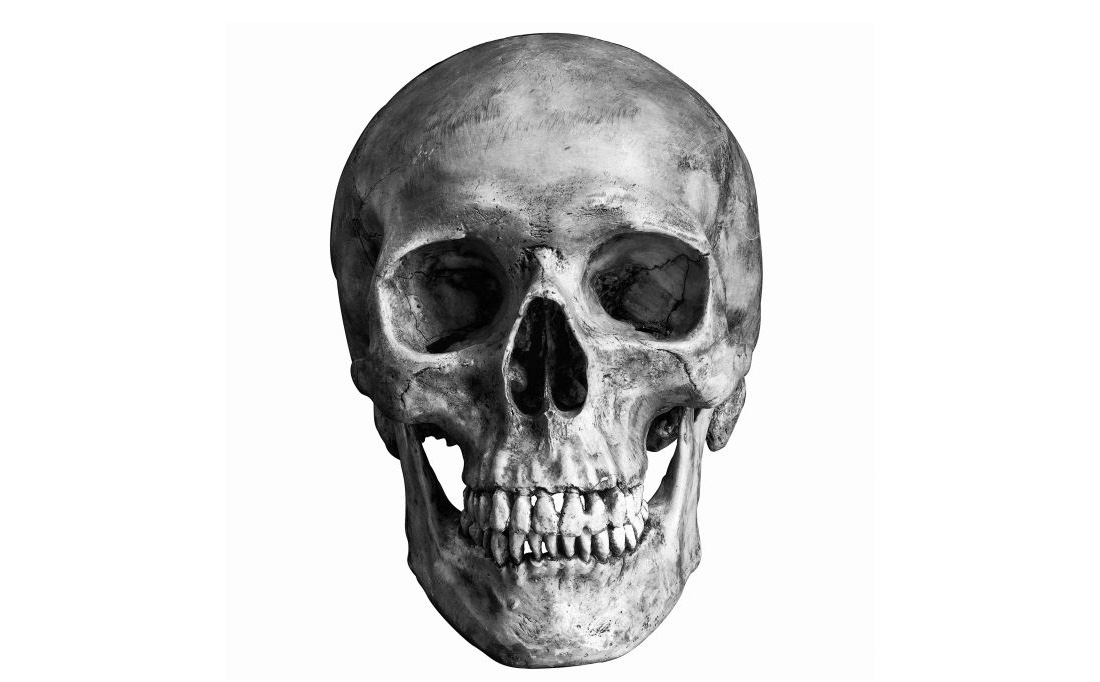
Here's a skeletal GLOG ruleset. Please, enjoy the BONES.


Click the skull for a PDF!

Features
  • 4d4 stat generation for 3 stats
  • No modifiers or derived stats
  • Stats as inventories
  • Simple rules for drugs, diseases, and friends/enemies.
  • Systems and items affecting each stat inventory to create pressure for space
  • Stress-relief enemas
  • And more!
Here's the Google Docs link for an evolving version.

Why These Rules
The following is reproduced at the bottom of these BONES, but in case you don't want to scroll down all that way, here you go:

I reduced the stats to inventories. That’s what a character is, when you pare away the derived numbers - a list of traits that make them an individual. Your PC isn’t defined by their Intelligence and Wisdom. They’re defined by what they know and how they use it, and that information can’t be reduced to a number disassociated from the concepts that define them. Bones PC’s may seem more complex than other OSR systems, but I’d like to argue that I’m simply increasing the information density of a character. The goal is to have all the items inside the stat pissing out. 

Part of the 6-stat orthodoxy is the diffusion of power across stats to avoid any one becoming too good. The risk of imbalance is greater with less stats, but I want my stats more impactful as opposed to struggling to find a purpose for certain stats outside niche class features.

I also included rules for friends because of the weird paradox inherent in dungeoncrawling, where you trust someone to save your life but are careful to not form a lasting attachment because they might die. I say bollocks to that. If y’all’re playing this game together y’all’re probably going to become friends anyway. No need to assume your PC’s are emotionally distant robots. Care for each other. I think the game becomes richer with that kind of investment.

I don’t like numbers. Fiddly +1 to X, -1 to X  - yes, it arouses the pattern finder, but sums are the first thing defenestrated by memory in stressful situations. Does balancing systems of bonuses make the game more fun or are they simply fun to design? Depends on you and your players. 

Does any of the philosophizing above really matter? I don’t know. If 3.5, 5e, or Mothership work for you, go for it. Play what makes you happy. But try to find out what doesn’t work, and make it better.

Have fun!

Wednesday, April 15, 2020

On Inventory

I had thoughts while soaping my hair (normal) and these thoughts were about RPG inventory (not normal. Are you okay?)

Broad assertion: in OSR games, one of the gameplay loops is about "managing inventory". Arnold and the GLOG drilled into my skull the usefulness of having Strength be inventory. Basically, your Strength score is equal to the number of inventory slots you can carry.

Now, it's important to note that this only refers to physical inventory. Things you can touch, etc.

Physical inventory isn't enough for me. I need more to represent The Things They Carried, which, as you'll recall, features a photo of Martha, Bibles, what it feels like when you don't want to murder humans (a cracking-popping-running sensation inside your chest), and how the stink of pig blood clots never really leaves. The title is about carrying trauma just as much as it is about literally humping 60 pounds of battle rattle outside Than Khe.

Now, obviously, half of those Things are real objects. The photo, the Bible. But they carry meaning beyond their brute physical presence. In game terms, these are personal objects, not crowbars, with no gold-for-XP value. But I'd argue they can be tools in a different sense: tools for a mental inventory.

Mental inventory is not a new concept. I think Red Kangaroo over at Library of Attnam first came up with it. Take all the things you have in your head, name them, and sort them. The higher your Intelligence, the more you can carry. Languages, skills, spells - toss em in the pile.

Space must be an issue for inventory to be effective. If things don't have to compete for inventory space, there will be no darling resource management loop.

I made a list, and even using skill ranks (oof) and then saying each rank ate up a mental inventory slot (bigger oof), most mental inventories are pretty sparse for first level characters. Say, about 6 things for wizards that speak 2 languages. How do I create pressure for space?

Well! Red Kangaroo also put together a pretty nice Darkest Dungeons inspired Trauma system for managing the stress of adventuring. This idea has existed around the fringes of the OSR for a while (I've seen Warhammer systems, Call of Cthulhu systems, GLOG systems, 5e Darkest Dungeon adaptations) but hasn't really caught on. Why?

Because inventory has to be able to flow between lists. It isn't enough for items to jostle for space on the list. A fascinating part of inventory is figuring out who can carry what, not just what can be carried.

Physical items can be transferred easily between owners. Skills? Languages? Spells? Stress?

Imagine four different cooks standing in front of four stoves. Each cook is given a random recipe, a time limit, and a random number of ingredients - some necessary, some not. They each have 1 square foot of counter space.

If each cook is able to move around, store things for the others, and assist them with the cooking process, the number of items won't be perfectly divided, but will reach an equilibrium dependent on what each cook needs, and the food will probably get made.

Now imagine the same scenario. Random ingredients, random recipe, time limit, same limited space. Except this time, the cooks are not allowed to help each other. Each one has to deal with their own items. Some will be fine. Some will drop ingredients or ruin their food.

These cooks are PC's. The first group dealing with physical inventory, and the second dealing with mental inventory.

Now, before we open the door to Vulcan mind-melding and hiveminds, some points must be made.

Physical tools are excellent because, in most cases, they are impersonal objects enabling one person to do a task as easily as another. Anyone can use a crowbar to kill headcrabs instead of opening things. This is part of what separates physical tools from mental tools.

Another part of that separation is investment. Learning languages, skills, and spells are all huge investments in D&D, and these mental tools separate some classes from others. If we allow transfer of this information, why have classes? How do we allow inventory flow without making character design irrelevant for characters that have disadvantages (doesn't know how to use weapons) to compensate for their advantages (can create illusions)?

A digression: For now, I think character classes are important. I'm not justifying my opinion here.

Dodging-the-question-counterpoints:

An important part of inventory is that the bad is just as easily transferable as the good. PC's should be juggling each other's Stress levels as well as making sure that everyone's boned up on their bombmaking skills.

Also, consider this: what's more interesting? Arguing with your party over how you're all going to spread out the stress of nearly dying, or silently calculating how many slots you can reliably fill with stress before going insane?

As a DM, I think player negotiations and problem solving around inventory space are engaging, if not always completely enjoyable for the players. But lasting satisfaction comes from solving difficult problems.

Also, how would PC's even transfer inventory to and from each other? What would they transfer? How long would it take? Can I transfer curses? What about class templates? What differentiates a skill from a class feature? What do you mean, that's just what they are? Is it okay to make a simulation of mental issues people actually struggle with? What kind of a DM are you?

exhales

Okay. The above are all valid questions. I'm not going to address them in this post. To back up my smack talk I need to write ANOTHER DAMN GLOG HACK to answer these questions with mechanics.

Well, guess what. It's written! It needs some final polishing, but, to fulfill a longstanding bet, I'm going to release it THIS FRIDAY.

TL,DR: The best kinds of inventory are the ones you can use to saddle other suckers with your shit.

And because I recognize the sweeping cop-out quality of this post, the Joesky Tax.

Joesky Tax

Photo of a loved one: As long as you possess this item, you may use it to store up to 3 slots of Stress. If you ever lose it, though, you gain Stress equal to twice the Stress in the photo.

Holy Book: You may take time once a day to pray with fellow party members. Whoever participates loses one slot of Stress.

The stench of blood: It follows you around. Every time you get close to someone new, they may gain Stress.

Thursday, February 27, 2020

The Butterfly Effect

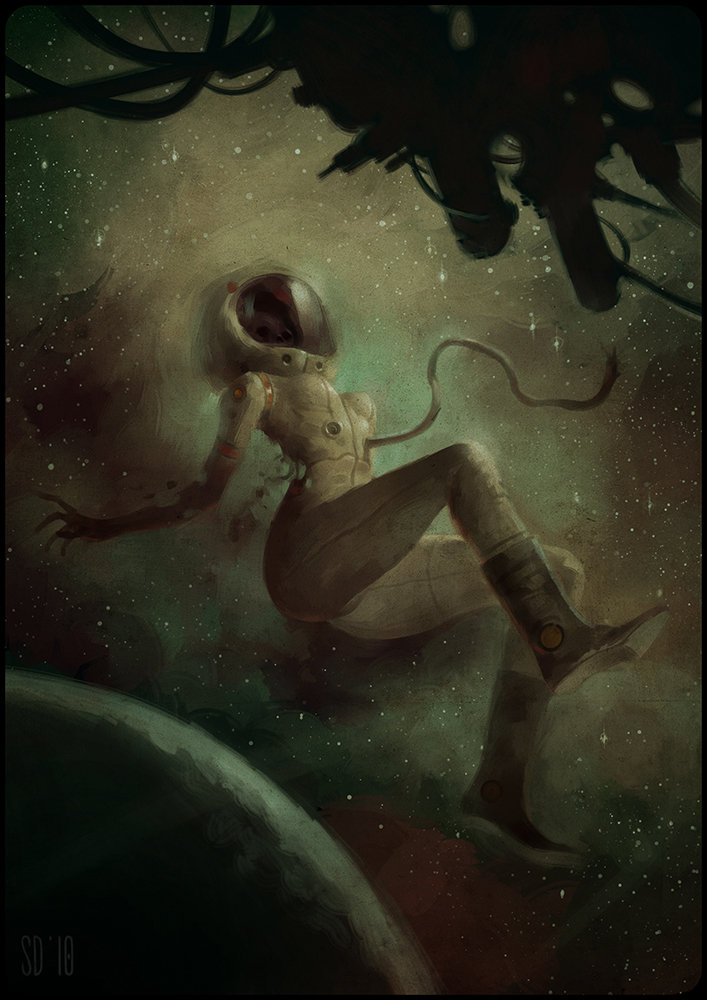
In each corp-issued spacer pack, and many of the ripoffs hawked to young vaqueres, there is a small yellow pocket tucked inside a flap. It contains a universal message:

Disclaimer: Do not use unless alone with no hope of rescue.
Instructions: Insert pill in mouth. Swallow with liquid. Relax.

The pack material may be thin, prone to tearing, contaminated, or looted, but the yellow pocket is taken seriously.

Space is the domain of entropy. Pure, unchained physics, tumbling and bouncing with all the lifeless joy of reality, gravity and light weaving tapestries of chaos into the infinite black.

This concert is rudely broken by the imposition of forged hunks of metal, steaming stations hurtling through the stars with intent and purpose. Entropy resents any state of order, especially that imposed by fragile creatures unsatisfied with their place in the universe.

It intervenes in small ways, where it can. Tools go missing. Circuits refuse to fire. Particulate clogs filters. Any action that unbalances the order imposed by spacers. Murphy will not be denied. Experienced vaqueros apply four simple rules to ward off the pressure of entropy:

1. A perfectly functioning station is a ticking bomb.
2. If you detect an outbreak of butterfly effect, act impulsively.
3. The simplest solution is the best one.
4. Three crewmembers are the absolute minimum for survival.

The longest lasting stations are often filthy and constantly threatening to tear at the seams, but their crews are Occam sharp and might live to collect one more check.

The second rule seems contrary to the cold logic necessary to engineer machines and mindsets hardened to survive space, but the black has its own rules, and the reed which bends will outlast the tree which breaks. When entropy gains a foothold and begins tipping the universal scales back towards balance, it's better to do what feels right than what is right. Split second decisions are always detrimental in the long run, but in that moment of panicked action, Murphy may lose interest and go ruin someone else's life.

The fourth rule derives from simple experience. It is categorically unsupported by any scientific study but almost always holds true in practice. Out of all the nonsense science, ritual, and bullshit practiced by spacers, this understanding has slowly coagulated into the general consciousness.

For whatever reason, the number of people needed to break even with Murphy is two. Three is enough to tip the scales in favor of survival. One lone spacer, stranded with a dead crew, is called a rubber band.

"See, it goes like this. You scan this band, ya? How it stretches and....snaps?

"Why does it snap? Can you tell me? No? Well, it snaps out of habit, kennit. It doesn't snap cause the material is stretched too thin, no. It doesn't snap cause its old and brittle. It can snap whenever it wants because anything is possible. Now, you scan, it snaps this particular way in this particular moment because the odds are so against it retaining cohesion down to the particruel. But when you spend a lifetime straining against the odds, the rubber band gets a little more give. Each time we cheat death, lil nebula, the list of possibilities stretches...and eventually, Murphy comes for you. How can it not? You brought the black upon you by cheating it so long, and the Sandman comes to collect.

"And in that moment, you need to stretch, nebula. Cause if you hold, if you don't give, your luck will snap. You'll be fine, but as you reason, as you deny Murphy, you'll give it what it needs to sever your  normal.

"And then, nebula? Can you guess what comes next? Hm? Not death, oh no, not for you. Everyone around you dies, and you remain, alive, cheatin the odds. Because you had to poke the bear, to understand why things go wrong outta nowhere. After that? You want to know, hah, what comes after that?

"Well, nebula, the butterfly effect never ends. And if you're really unlucky, you'll find out how deep the rabbit hole goes. Now fuck off. This is my forgetting time."

Sergio Diaz
There are always a certain kind of people sitting in taquerias. Not alone, not together, but distant. They all like coffee anytime. They all have little tchotchkes on necklaces or bracelets. They all drink like drowning fish and wear goggles even in near darkness. They always have guns and they play idly with knives. When they talk, it's maniac, short bursts of conversation interspersed with black silence. Everyone knows what they do, which is why nobody ever offers them a job. 

"What, you again. Don't you have a crew to pull together? Be damned to black if you think yer getting me on a station.

"You what to know why they call us monarch hunters? Shit, nebula, weren't you listening? Ain't you Googled something by this point? 

"....you know, and you want to be one?

"AHAAHAHAHAAAA......alright, kid. Sit down and I'll buy you the only drink you're ever getting off me. Savor this. It's your best friend after your first butterfly. Shit, don't puke on me or I'll break your legs.

"Anywhere, you want to be a monarch hunter? Well, kid, that's the easy job. Not what you thought, hotrod? No, the real dangerous job is a cocoon popper. Yes, I know what the forums say. You should know they speak bullshit from birth, wise up. 

"See, once the butterfly effect finishes and the monarch emerges, the station's a lost cause. Nuke it from a good distance and enjoy the fireworks, scan the flotsam, and pick it over for confirmation of death. 

"But when the cocoon's still intact? That's when the station's still good for salvage if you cut the rot out. So you gotta go in, you and your mates, and creep through the blood and metal. Yes, there's always blood. What, you think people die neat in space? Anyway, here's the difference between a bug cocoon and a space cocoon: the last one moves and thinks and kills. Ya didn't picture a big old sleeping bag strung up near a reactor, did ya? Kid, Birth in Black is some steaming slag. How much of that old flix did you believe?

"So, you're creeping through the station, looking for the cocoon. No lights unless you want to be food. If - if you're really lucky, and docked and boarded quiet and dark, it won't be hunting. If you made just one noise outta the ordinary, it'll know and it waits for you. No, I'm not kidding one noise. Cocoons have been holed up in the same shithole for months and they know it like their bones. You're stalking the lion in its den, and you can't damage the den too much because the zoo wants to rent it out to the next stupid occupant. Crawling and listening, crawling and listening. Never take your helmet off no matter what the scans say. That air is cursed and the cocoon usually fucks it up anyway. 

"What do they look like? Well, cocoons usually look like humans. Two of most everything. Eyes, ears, arms, legs, whatever. But the way they move....kid, they're dead. Well, not literally dead, that's probably not the case. But they move careless, they don't care what they break. Those eyes....there's nothing like them. No, I won't describe them. You gotta understand, they aren't human anymore. They belong to the black.

"As bad as it is playing pop-goes-the-weasel with a cocoon, the real terror comes when you figure out you're up against a monarch. Those things make your toolkit do the hokey pokey, and they know how to stalk, how to play dead, all the tricks predators know dragged outta the corners of our skull. And the worst part is, they're beautiful. Each one is its own hell, but after years spent in the black where all your color comes from flix and games, real colors....real colors, kid,shades you didn't know existed that make your eyes water and teeth hurt. 

"Of course, you pay a price for seeing them. Usually fellow spacers, but there's other prices. The good hunters, the ones that get the job done, the lucky ones, the ones with solid intel, they get to keep their eyes. All the rest of us saps...well, once we see a monarch...I've got a catheter on my damn head for a reason.

"Heh. You want to hunt these things? Yeah, you might get lucky and go viral, assuming you have any looks left after your first time being hunted. 

"There was a time I'd take you along because I used to think kids have a right to adventure yadda yadda yadda. I don't want to clean your blood off my suit, I've done it enough, and I certainly don't need to hear any more screams. Enjoy the drink, go find a better job, and seriously piss off this time. If I see you here one more time, I'm going to kick your guts out. Now, if you're terminally stupid, listen:

"My ship's the Charybdis. If you show up at 0400 with good gear, I'll take you on the last trip of your life. No, I'm not telling you where it is, and don't bother checking the logs. I've pissed off corpo too much to use my real name. Hell, I could be a drunk-ass miner luring you into a mugging. Now let me get back to forgetting."

Harley Wilson

In the inky cradle of entropy, someone who beat the odds too many times can beat them in a new way, and become something greater than the sum of their parts. 

The first step is isolation. It's surprisingly easy to maintain a station with only one spacer, once Murphy has its tendrils in you. First comes the relief of survival, then the loneliness, then the power failure. Always the power failure. It only takes the light. After that, desperation, screaming madness, and catatonia. The human in the grey matter shrivels and dies. And, against all odds, in complete darkness, something wakes up.

It's a new life, and it explores its home, relearning movement without eyes, intuiting adjustments to allow access to all parts of the station. And the cocoon drags what's left of the human it was to a small, warm, comfortable place. Maybe it produces fabric to shroud its nest. Maybe it fuses layer upon layer of steel to a shipping container to create a crumpled, tunnel-ridden ball. Maybe it wreathes its den in layers of lethal radiation from a cracked reactor vent. Maybe it vents part of the station and makes its bed in complete vacuum. 

Not that it sleeps, of course. Only consciousness needs sleep, and a cocoon has nothing we would call a mind. No, the bed is for when it wants to be reborn in a cracking, glistening process, like shedding a person-shaped egg. 

And the monarch is beautiful and terrible, bending the entire station to its will, singing in electromagnetic spectrums that scramble radios and induce dementia. 

The monarch's song has another power, too: it increases entropy. Stations nearby will experience more and more butterfly effects, and if the monarch is allowed to sing, or, stars forbid, migrate, all close stations will succumb in a chain of fantastic coincidences. 

Out of all the first series of station launches, only a handful of humans survived, and only a few monarchs were killed. Some nests began to move again after most function ceased, the butterflies migrating to parts unknown.

And judging from intermittent, increasing periods of comms static, some have begun to return. 

--------

I wrote this with Mothership in mind, but it could easily adapt to any space game you care to run. 

How Is This Station Going To Screw You? (d8)
  1. All the doors have been fused shut. How is the cocoon getting around?
  2. Leaking reactor. Better hurry....and your radios are futzed from the radiation.
  3. Repurposed drones seek to repair station, repair your gear, repair you, or kill you. Mostly kill you.
  4. Parts of the station are gone, and all areas larger than a bedroom are filled with chunks of debris.
  5. AI driven insane by isolation and lack of maintenance, completely ignorant of the current state of cocoon, treats cocoon as commanding officer.
  6. Malfunctioning cryounit traps past crew in stasis to preserve them, releases them when it detects more humans.
  7. Rogue mining drone in hibernation. Wakes up and seeks to recover valuable component to fix itself upon spacecraft arrival.
  8. Debris storm after arrival. Need to assess spaceship damage and scavenge parts.
What Powers Does This Cocoon Have? (d20)
  1. Bend your perception of time. 
  2. Wipe itself from your eyesight.
  3. Alter temperature levels from below zero to above boiling.
  4. Remove your ability to feel pain.
  5. Make you hear voices. 
  6. Imitate noises perfectly.
  7. Interfere with electronics or nucleics.
  8. Ignite with a touch.
  9. Bend metal like clay.
  10. Produce sensory organs that resemble wiring exactly.
  11. Host a technological device.
  12. Kill your immune system with a look. 
  13. Lethally radioactive when in the same room.
  14. Vibrate at a frequency to shatter glass and hard plastics.
  15. Emits pure hydrogen and is immune to fire and explosions.
  16. Secretes sticky, inflammable, corrosive goo.
  17. Increase air pressure.
  18. Produce and absorb electrical current.
  19. Symbiotic fungus colonizes all surfaces, is inevitably fatal to all organic life.
  20. My Stars These Glorious Scintillations Are Enrapturing
All monarchs, regardless of their looks, possess certain abilities. They are incredibly strong, do not need any atmosphere, and are immune to all forms of radiation. The butterfly effect is massively amplified around them, and any gear too close will begin to suffer catastrophic failures. 

They are always singing and talking, streams of radiation pouring from them and illuminating the impossible colors of their bodies. This song can be altered to prevent any transmissions or massively boost them. It also interferes with communication between neurons, leading to quick dementia, hallucinations, and eventually catatonia. Looking at them indirectly, with a spacesuit, causes cataracts to form. Looking at them directly sears their image into your eyes forever.

They want to travel the stars and show us the orchestra of the universe. Unfortunately, they're not quite sure how, and most of their methods involve ripping pesky chunks out and replacing them. Most spacers vivisected this way die a quick death, but there's always the chance of someone beating the odds...

What Is The Monarch Capable Of? (d8)
  1. Gravitational anomalies. Serious ones.
  2. Manipulation of computer systems by thinking. AI can resist.
  3. Creating clones after getting DNA sample. They fall apart after several days.
  4. Combustion ceases to work. 
  5. Consumes all electromagnetic radiation.
  6. Flight. Shit.
  7. Manipulates magnetism.
  8. Come My Child, Let Me Show You The Glory Of The Stars

What Does This Monarch Look Like (d6, roll four times)

It's dreadful colors are...

  1. Amber with shimmering cyan and lurking red
  2. Bright magenta with opaque black and yellow fringes
  3. Staticky chartreuse with dripping white and opalescent red
  4. Oil-slick pink with dark purple streaks and sparking black
  5. Matte orange with fluid grey and veins of white
  6. Glossy lime with chocolate ridges and crimson beads
Its appendages are....
  1. Keratinous and multitudinous
  2. Glasslike and constantly flowing
  3. Shrouded in clouds of seeds like dandelions
  4. Mucous dripping off hard edges
  5. Flaps of hair oscillating, concealing holes
  6. Acne-studded, wet musculature
Its body is....
  1. Radially symmetric, with evenly spaced appendages
  2. Lopsided, with pulsing, downy bags of organs on the larger side
  3. Trunklike, with irregular crustacean plates and antennae
  4. Perfectly anorexic, with each tendon and bone outlined
  5. Organs connected by floating silky strands
  6. Kelpy fronds quivering like plucked strings
And its head, oh stars its head is...
  1. Chitinous petals arranged in the shape of a rose that unfold to reveal dark milky orbs
  2. Flesh bulging through a skull, pulsing veins and shuddering eyes encased in dry bone
  3. Luminous radiance emitted by floating polyps
  4. It...doesn't have one? Wait. What's that in the corner of my eye?
  5. A void of perception. Your head is drawn towards it.
  6. A cat's cradle of relaxed muscle that tenses when it perceives a threat. 
Milan Nikolic

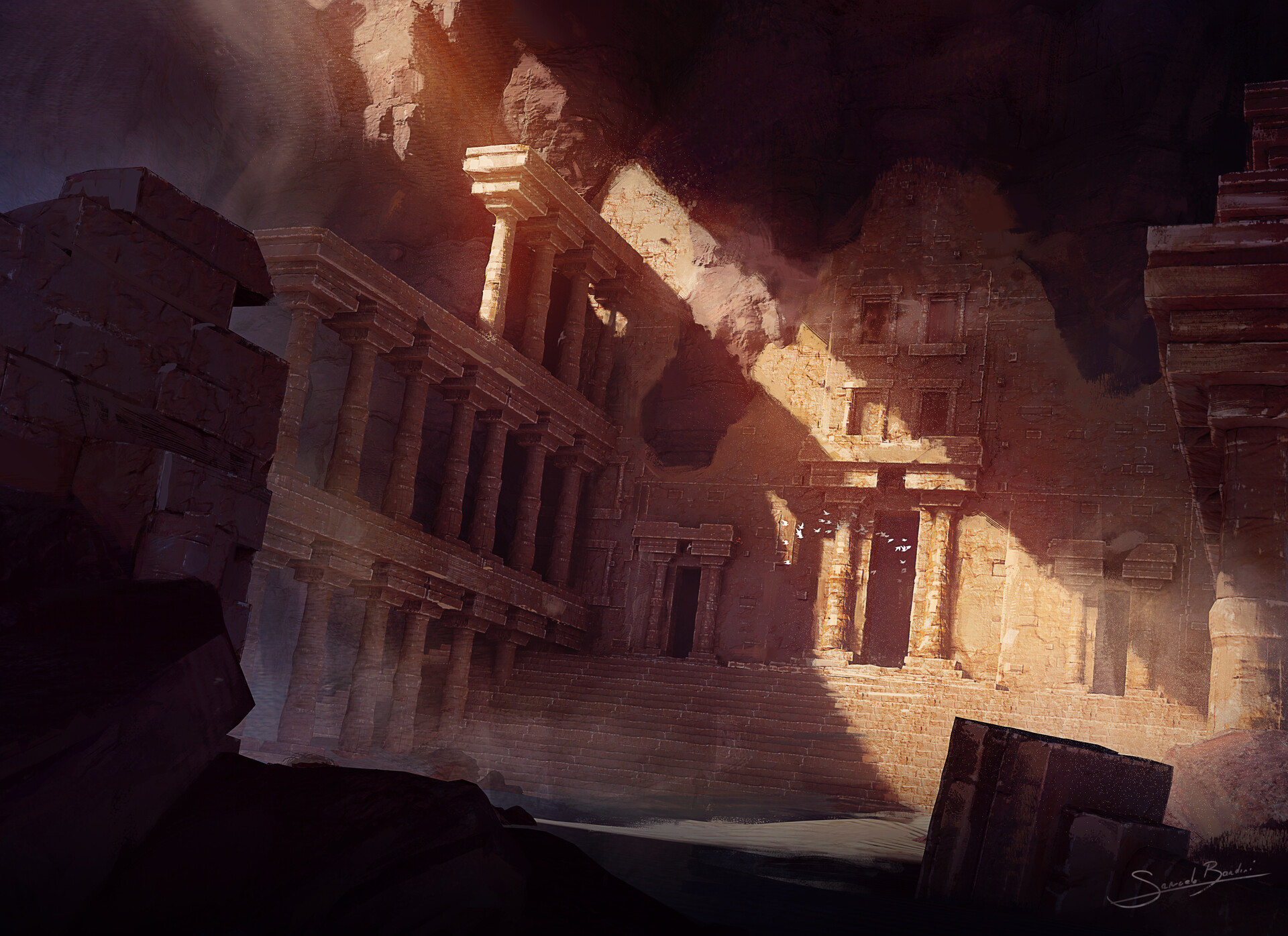
10,000 Chambers of the Cnite King

Deep within the turgid reaches of the Samarkand Desert, a lone crag of withered sandstone presents a visage long scoured by time.  Samuele B...