Wednesday, March 6, 2019

GLOG Class: Veteran

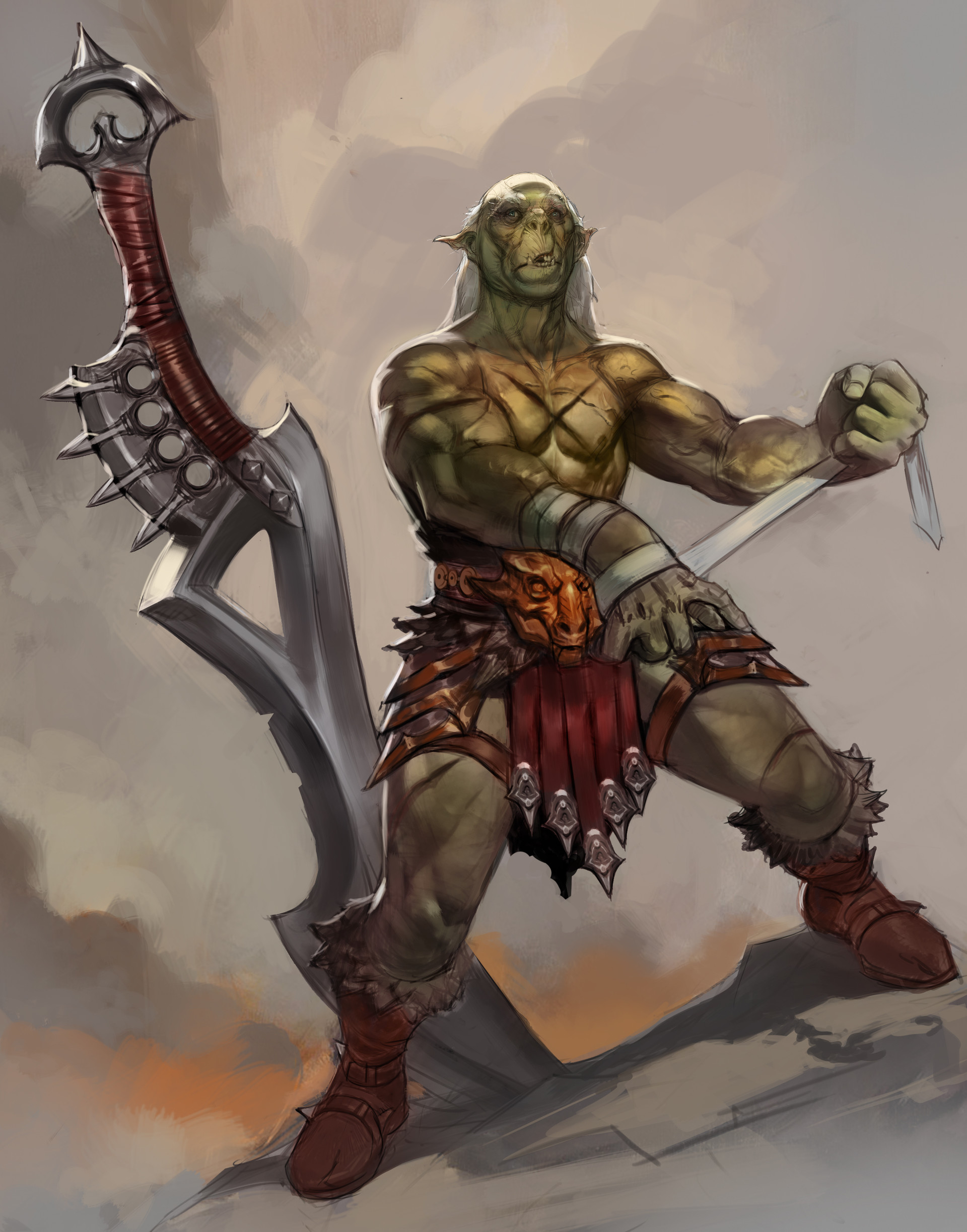
On a beautiful summer day ripe with the musk of freshly felled hay, your country called you to fight. Or, after the raiders had left, you crawled over to the mace in your mother’s cold hand and swore to kill every last one of them. Or, after the sermon, with the priest’s shouts of blasphemy burning hard and bright in your mind, you bought an old sword with intent.

It doesn’t matter.

There were battles, bonds made and broken, men and women laid out on the ground, blue with the blanket of death. You stacked rocks with scabbed, trembling fingers atop the bodies of your friends, or brothers, or sisters.

It doesn’t matter.

What matters is that you are now breaking the oath you made after your last battle. Against all reason, against the tenuous feeling of your body, against the little voice in your head saying that now, you might actually die, you have picked up arms once again.

There is something. A person, a promise through shredded lips, a doubt. You will not rest until they are dead, or the promise fulfilled, or the doubt assuaged, or your own death.

Whatever it is, though the gates of hell stand in your way, you will blast them down and with your last breath seize your prize.

GLOG: Veteran
Johannes Helgeson
Thanks to the wonderful Lexi for her feedback during the editing process!

A: +2 Old Wounds, Pangs, Vow, +1 Fighting Style
B: Drinking Buddies, Weathered, +1 Attack
C: Scores, Recall, +1 Fighting Style
D: Venerable Glory, +1 Attack

Old Wounds are the injury you suffered in your previous life come back to haunt you. Fragments of your skills remain, but using them risks tearing something. Your Old Wound dice are represented by d6’s.
When you hit with a weapon, you may roll any number of your WD (Wound Dice) in addition to damage. If the attack roll was even, add all even WD to damage; if the attack roll was odd, add odd WD instead. Sum all the WD that you didn't add and trigger the relevant Pang, then expend those dice until tomorrow.
When you take damage, you may roll any number of your WD. If the damage was even, subtract all even WD from damage; if the damage was odd, subtract odd WD instead. Sum all the WD that you didn't add and trigger the relevant Pang, then expend those dice until tomorrow. If you reduce an instance of damage to 0 using WD, you automatically trigger a relevant Pang with the sum you used to defend.


Pangs are what you suffer when your Old Wounds stir again. They range from mildly debilitating symptoms to devastating reopenings of old wounds. When your dice don’t match up as detailed above, check the sum of the unmatched dice, consult the Pangs table, and suffer its effects.

Your Vow is the reason you bear arms again. You will not rest until it is completed. You will never act in a way that directly contradicts your Vow, and if you are charmed to act against it, you can make one additional save with a +1 bonus for every Veteran template you have.
For every Veteran template you gain without breaking your Vow, you get +1 to saves against effects that would instantly kill you.

Pick a Fighting Style from Mimics and Miscreants. Pick well.

Drinking Buddies are people you served with, veterans of your war(s). You can call upon them for a small favor, like dinner and a place to sleep for the night, or an audience with the local baron. You may ask them for a larger favor, but they’ll ask a favor of you in return. There's at least 1 Drinking Buddy in any small town, and more in larger settlements.

You’re Weathered from past trauma. If your game uses stress points, trauma dice, or similar mechanics, you can ignore the first time these effects trigger. You can sleep outdoors in your armor (unless it’s plate) comfortably as long as weather conditions permit, and you have +1 to saves against exhaustion for every Veteran template you possess.

Scores are relics of your violent past that bubble to the surface as word spreads that you bear arms again. When you return to town after some time spent adventuring, roll a dice.
On evens, a person you served with, a Drinking Buddy, or a relative of such will seek your help avenging a major wrong.
On odds, an old enemy, a Drinking Buddy you offended, or a relative of someone whose death you were responsible for is waiting for you to settle affairs.
If you reject pleas for aid or put off resolving old conflicts, your Drinking Buddies will no longer extend aid until you tie up loose ends. For every Score you settle, you can reroll a Pang you dislike one time.

You may Recall knowledge from your past life. Once a day, you can make a skill check as if you knew about the relevant topic.

You are, now and forever, a Venerable Glory. The first time you kill a creature in combat, all hostile, sentient creatures must Save or refuse to attack you until you deal damage to them.

Carlo Arellano


Old Wounds (1d6)
1. Right arm
2. Torso
3. Left leg
4. Head
5. Left arm
6. Right leg

How Did I Get This Wound? (1d6)
1. Pulling an unconscious friend out of the battlefield into cover.
2. Trampled by pack animals during a night surprise attack.
3. Sniped from a distance. Spent 16 hours curled up in a hole, not daring to move.
4. I tried to end myself to forget all my sins. It was only after I did it that I realized I wanted to live.
5. Stumbled across army corruption. A trio of soldiers was sent to silence me. I silenced them.
6. Wounded from behind. None of my fellow soldiers would confess to it, but I have my suspicions.

Head Pangs (Old Wounds Sum):
1. Mild headache. No negative effects.
2. Sharp spike of pain. -2 to attack rolls for 1 round.
3. Hallucinate a dead enemy as a priority target for [sum] rounds.
4. Stunned for [dice]x2 rounds.
5. -3 to mental activities for [sum] rounds.
6. Agony for [sum] rounds.
7. Flashback to your war for [sum] rounds. All creatures within sight are treated as enemies
8. Alien limb syndrome for [sum] rounds. The limb is hostile to you.
9. Unconscious for [sum] rounds.
10. Gain a Fatal Head wound.
11. You drop to 0 HP.
12. You die. No save.

Torso Pangs
1. Mild abdominal ache. No negative effects.
2. Sharp spike of pain. -2 to attack rolls for 1 round.
3. Vomit blood for [sum] rounds.
4. Stunned for [dice]x2 rounds.
5. Lose 2 HP per round for [dice]x2 rounds.
6. Agony for [sum] rounds.
7. For every action or 10 feet of movement, you take [dice] damage for [sum] rounds.
8. Overwhelming exhaustion for [sum] rounds.
9. Unconscious for [sum] rounds.
10. Gain a Fatal chest wound.
11. You drop to 0 HP.
12. You die. No save.

Arm/Leg Pangs
1. Mild ache. No negative effects.
2. Sharp spike of pain. -2 to attack rolls for 1 round.
3. -3 to physical activities for [sum] rounds.
4. Stunned for [dice]x2 rounds.
5. Appendage moves half as fast for [sum] rounds.
6. Agony for [sum] rounds.
7. Appendage goes limp for [sum] rounds.
8. Every time you use the appendage, you take [dice] damage for [sum] rounds.
9. Unconscious for [sum] rounds.
10. Gain a Fatal wound in the appropriate area.
11. You drop to 0 HP.
12. You die. No save.

Design Notes

I wanted to make a fighting class that used hacked MD for non-magical abilities. While the Veteran lacks the sheer tactical versatility of the many Fighter variants out there, and has significant overlap with the Fighter, I feel that it benefits enough from its non-combat abilities to be a good option for any adventuring party. If I were to kill all the fighters, I'd replace them with this, the Knight, the Assassin, the Barbarian, and a few other niche weird classes. 

Friday, March 1, 2019

OSR Class: Warlock

Edit 7/26/19: changed random spell rolling from 2d6 to 1d12.

Fighters cleave with merciless metal. Clerics/mystics create displays to further their gods. Druids scrabble and tangle, loosening the hardpack foundation of civilization. Wizards...do wizardly things.

Warlocks?

A soul is a piddly, wretched thing. It animates a single fleshy shell and then weeps after death while being plucked away like a wet dishrag in a tornado. A soul is worth more than molochian vaults of spoils and less than the freshest, most succulent of the apple crop.

What, then, defines the worth of a soul? Why do some people write off the ephemera within in exchange for cryptic messages, debt-infested spells, and byzantine demands? Why do strange beings accept these souls?

Karlos Warlock

A commonly said aphorism holds that success is being in the right place at the right time. Something that is not so commonly said holds that the soul is a reflection of oneself, waxing and waning with its blood-soaked glove.

Tyrants, archmages, bishops, serial killers - each of these have powerful souls. Junkies, misers, gluttons - these have weak, fluttering things, tethered to their body like a butterfly pinned to a starched shirt.

As your life is what you make of it, so is your soul. Power without equals power within. All souls begin equal, but all souls end up extremely different. Discerning patrons have a knack for determining the potential of a given soul. Potential is a sort of spiritual cryptocurrency in the otherworlds, waxing and waning with the current apocalyptic chance. It's unreliable and potentially useless, but those otherworlders who desire a way out of the typical power structure try to hoard and nurture sources of potential. Occasionally Requiem hangs in the balance.

Every warlock makes a pact, and every pact is inscribed on two places: the surface of the warlock's brain and their patron's personal record. Warlocks of exceptional puissance find the inside of their skulls engraved with a negative of their pact, and the details of a pact can be inferred from an intact warlock skull.

If you are a warlock, you are probably desperate, impulsive, and have no positive qualities except for determination. You're going to be a wonderful tool.

Warlock Class

Starting skills and equipment will vary for each warlock.

New GLOG spellcasting mechanic along with [sum], [dice], and [best]: [Size], which represents the [size] of the dice.

Boon: Some bonus your patron gives you. Leaves a mark if you know where to look.

Favors: Small magic much like orisons or cantrips.

Goals: What the patron wants, and how hard it will push its warlocks to achieve them.

A: +1 Credit, Debt, Obligations
B: +1 Credit, Sacrifice
C: +1 Credit, Beseech
D: +1 Credit, Patron's Gift

Credit is the power your patron lets you borrow, represented by d6's. The maximum number of Credit dice you can borrow per spell is determined by your number of warlock templates.
If you roll any doubles while casting a spell with Credit, you gain +2 Debt. If you roll triples, gain +3 Debt. If you roll quadruples, gain +4 Debt. If you have MD from another source, these MD can also trigger Debt gain if you cast with Credit.
If you cast a spell with only 1 Credit, you gain +1 Debt when you roll the top 2 numbers of your Credit dice. (e.g 3-4 on 1d4, 5-6 on 1d6, 7-8 on 1d8, etc)

Debt is the ineffable thing you owe your patron for lending you its power. For every 2 points of Debt you possess, the size of your Credit is decreased by one. d6->d4->d2->0. If you accrue more than 6 points of Debt, your patron will simply kill you in some instant, hideous fashion and collect on your soul, no save.
Performing an Obligation removes 2 Debt.

Obligations are what you must complete to pay off your Debt. All accrued Debt must be removed before you can gain the benefits of the next Warlock template, including hit points. Obligations range from a small task to an entire adventure. Obligations reflect the patron's desires and can range from a bloody sacrifice to delivering a hostage.

Sacrifices are temporary and damaging but can help boost the power of your spells. As you cast a spell, you can deal xd6 damage to yourself with a small one-handed weapon. For every 3 points of damage you take, every Credit dice invested in the spell being cast increases by one [size] category. You can never increase a die's [size] more than 3 times.
If you use a Sacrifice to power a spell that requires concentration, you cannot regain the lost hit points until the spell ends.
If you drop yourself to 0 hit points while Sacrificing to your patron, the spell succeeds (unless it requires concentration), but you gain a Fatal Wound in an area of your choice.

Beseech your patron for help if you’re in a tight corner, and they'll probably send it. The form of help is dependent on how much they like you at the moment (accumulated debt) and what the patron considers help. You must be able to speak to do this. Always accumulates +3 Debt.

Patron's Gift is a permanent beneficial mutation that reflects the strength of the bond you've established with your patron and marks you somewhat like a dog collar. Patrons cannot revoke this gift, and each patron gives a different gift.

You can use scrolls or wands like a wizard can.

Roll 1d12, rerolling duplicates, to get your starting spells. For every warlock template you gain, you choose one spell and gain one spell randomly.

Becoming a Warlock to escape Dooms
Patrons will gladly accept wizards and such as warlocks on a one-to-one basis. When a wizard become a warlock, they must undertake tasks for their patron before gaining access to all of a Warlock's powers.
Mechanically speaking, prospective warlock converts work by two simple formulae: 1 Doom = 3 Debt, and for every wizard template you have, you gain a warlock template. This Doom Debt does not reduce the size of your Credit dice. You also lose all your old Wizard features except for a number of spells of your choice equal to the number of Wizard templates you had.
Prospective warlocks have access to Credit, (and can gain Debt as usual) but all Debt must be paid off before the new warlock is able to cast Favors, Sacrifice, Beseech, gain their patron's Boon, or gain their Patron's Gift.

Warlock Multiclassing
You can’t take/have another template (WITH ONE EXCEPTION) in another spellcasting class of any sort unless you get out of your pact. Knights, Fighters, Barbarians, etc, are fine.
If you are a Sorcerer and you wish to bind your godly magics (why would you do this) you may make a pact. Thereafter, when you roll doubles, triples, and quadruples, you gain Debt instead of exploding or the like, and your dice (regular and Instability) decrease as if they were Credit. If you ever accumulate 6 or more Debt, your patron will withdraw their stabilizing influence and you will roll on the worst Mishap table possible with a number of d6’s equal to your current Debt. Patrons love sorcerer warlocks; they make their own power and act like conceited mobile nukes.

Example Patron:

Old Scratch

Russell Michelich

Starting equipment: a forked dagger, 1 dose of some good drugs, a reactionary pamphlet, and a good pair of walking boots. Fiddle optional.

Boon:
If you sacrifice a creature with HD greater than 2 times your warlock templates, you ignore the effects of Debt on your next spell. Tears of blood fall from your eyes at random intervals.

Favors:
You can cause blood or other bodily fluids to appear on things by touching them. You can delay this appearance for up to an hour.
You and your possessions are unharmed by any fires smaller than a campfire.
You can see through the eyes of goats that you’ve touched as long as you know where they are. One at a time.

Goals:
Old Scratch desires the ruination of all established organizations and a world full of the natural state of man - nasty, brutish, impulsive. No societies, no chains. He is kind when he senses weakness and an absolute tyrant once he ensnares a soul.

Obligations: (1d8 + 1d8)

1d8
Sacrifice 2 x [Debt] creatures consumed with
Corrupt [Debt] creatures into practicing relentless
Lure [Debt] creatures infested with another sin into also practicing
Form a mob of 6 x [Debt] creatures to lynch a target who you accuse of
Smear [Debt] upstanding, powerful creatures with false evidence of
Blackmail [Debt]/2 influential creatures into committing an act of
Inflame a murderous rivalry in 3 x [Debt] creatures over an act of
Convince [Debt] mothers to kill their innocent children. Do not roll on the below table.

1d8:
Wrath
Sloth
Envy
Pride
Gluttony
Roll twice and do both. Reroll 6’s.
Greed
Lust

Patron’s Gift:
If you somehow survive the tasks Old Scratch saddles you with, your body spasms and cracks as you grow a lizard tail and goatly horns from your forehead, you feet fuse and split into hooves, your eyes burn yellow, and your skin darkens to red. In exchange for this transformation, your skin cannot be broken by refined metals. Typical executions of your ilk usually involve inventive ways of pulping or drowning human-sized targets.

Spells:

Fireball
R: 200’ T: 20’ diameter D: 0
Objects and people take [sum] damage.

Smell Sin
R: sight T: [sum] creatures D: concentration
By focusing your attention on a creature, you can smell [dice] sins it embraces and has committed most recently. Greed is a stench of rotting wood and old locks, burlap bags and musty hiding spots. Wrath is the coppery smell of blood and oiled steel. Sloth is the smell of piss saturated sheets and room temperature beer. Envy smells delicious.

Monsterize*
R: touch T: creature D: 10 min
Target saves or becomes a horrible monster version of itself. Monsters get +1 HD (+4 max HP, +1 to hit, +1 to save). Player characters have their Strength raised to 15 (unless it was already higher). The target also flies into a rage, and becomes incapable of tactics, kindness, or retreat, even if urged by friends.

Invert Speech
R: 10 x [dice] radius T: [sum] creatures D: [dice] minutes
Targets in the radius of this spell must Save or either perceive all writing within range or all conversation as saying the opposite of what is intended. Words and tone will be twisted as subtly as possible.

Flay
R: 100’ T: [dice] creatures D: 0
Creatures of your choice with [HD] greater then or equal to [dice] take [sum]/2 damage and have their skin (should they have skin) removed and fall at their feet. Save for half. If this kills a creature, their skin is neatly pinned to the nearest flat surface.

Socialize
R: 0 T: self D: [dice] hours
You are clad in the typical garb of the region. 1 [die] gets you the lowest form of clothing. 2 [dice] gets you robes of the middle class or equivalent. 3 [dice] gets you noble clothing. 4 [dice] is truly sumptuous clothing. You also gain the ability to judge social status accurately from unfamiliar clothing while the spell is active.

Look!
R: 10 x [dice] radius centered on you T: [sum] creatures D: 0
You point and shout at something oh god what is that. Save or look. If 3 or more [dice] are invested, creatures may actually believe they see something.

Murderer’s Hands+
R: 30’ T: [size] creatures D: [sum] minutes
Targets must Save or their hands or equivalent appendages twist into hooked, serrated metal appendages whose damage varies. 1 [die]: 1d4, 2 [dice]: 1d6 3 [dice]: 1d8 4 [dice]: 1d10. They cannot use these hands for anything but harm.

Pyre**
R: 100' T: [sum] creatures or objects D: 0
Targets must Save or catch on fire. Targets that are completely inflammable (soaked creatures, metal, etc.) do not need to Save. Targets that are very flammable (soaked in oil, dry wood) may not get a Save. You can target this spell precisely enough to light the wick of a single candle in a bundle, provided you can see the wick.

Sermon
R: voice T: [sum] + [dice] creatures D: [sum] minutes
You deliver a passionate speech about whatever topic you wish. Targets must Save or remember what you said and discuss it with other creatures compulsively for [dice] days.

Entangling Smoke**
R: 50' T: [dice]x2 objects or creatures D: varies
Target creature or object is grabbed by tendrils of thick black smoke. Save to negate, prone creatures automatically fail. Target moves at half speed and takes a -2 penalty to Attack until it can win an opposed Strength test against the smoke to end the effect. The effective Strength of the smoke depends on the dice invested. 1 [die]: 10, 2 [dice]: 14, 3 [dice]: 18, 4 [dice] 20.

Emotionate
R: 10 x [dice] T: [sum] creatures D: [dice] hours
Target creatures must Save or have their current state of emotion amplified. Sad creatures become inconsolable, angry creatures vibrate with rage, lustful creatures become obsessive. Creatures that are not feeling any strong emotions will have their next emotion (reaction) magnified.

Artyom Tarasov


Apocalypse Now
R: sight T: [sum] creatures and self D: concentration
When you cast this spell, roll your dice.
If one 6 comes up, things go subtly wrong in the given area. Crows with human eyes. That steel dagger is actually painted wood. Just unsettling enough to be noticeable, but easy to rationalize.
If 2 6’s come up, things go wrong. All target creatures take [dice] damage and witness the frayed edges of the world. Colors shift. The sky is green. The sun is your teacher with a black snake in her hand, watching. Leaves shuffle along the ground like snails, and when they move over your feet, they scrape them to the bone.
If 3 6’s come up, shit is fucked. Mother goats suckle at the behinds of their kids and wander away from the small, wrinkled lumps of skin left behind. Tree branches wilt into roots that plunge greedily into exposed flesh. There is a second heartbeat inside your skin, and you feel a pressure like tautened fabric in your neck. Something is stirring. If you play with insanity points, break them out. All creatures within range except you take [dice] + [size] damage. If this reduces them to zero hit points, a demon arm with an impossibly long nail reaches out of their throat and slits them neatly down the middle, then crawling out. These demons are indifferent to you and hostile to everyone else.
If 4 6’s come up…nothing happens. The world stops for a complete second and then carries on. For the rest of your life, though, occasionally things will seem different. Honey was a lighter color and silk wasn’t so thick. Was the sky always green?
Regardless of 6’s, if your [sum] = 13, then in 13 days Old Scratch will unzip you like a coat, stretch, and proceed to commit unspeakable acts on the nearest civilized populations until put down. You know this.

Casting this spell is a great way to invite erasure by the normative reality matrices unless it succeeds completely.

* - spell comes from Arnold K's biomancer.
+ - spell comes from Remixes and Revelation's warlock.
** - spell comes from Skerples's excellent list of 100 Orthodox Spells.

Wednesday, January 30, 2019

Armoires and Armors and Initiative

Armors in 5e fill very specific niches. Light, medium, heavy.

Apologies for the formatting

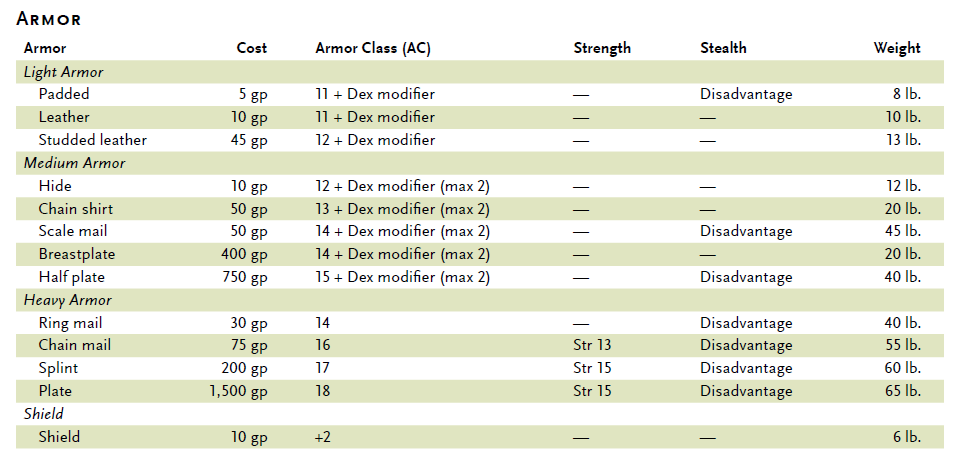
For players who want their character to have a decent AC, there are only 3 types of armor worth wearing under standard 5e rules: studded leather, breastplates, and full plate. Why?

Well, it's rather self-explanatory using the chart. For Dex-based characters, studded leather lets them maximize their Dex bonus unless they fiddle with half-plate and the Medium Armor Master feat, which Brandes Stoddard goes over in his dissertation on medium armor. 

The breastplate is a better option than the half plate if you have to make any Stealth check throughout your campaign. Could the cleric Guidance you, or the bard Inspire you, or the rogue Cunning Action the Help action to remove the disadvantage and provide a bonus, you ask?
Yes, but they'll likely be helping...

...the fighter in plate armor who already has disadvantage and a meh Dex score because he put a good score in Strength. Seriously, though, 18 AC is really neato. Who cares about the enemy noticing the mobile metal statue when it's hard to get at his meaty insides?

This, for me, is part of the Dexterity imbalance of 5e. What with initiative modifiers, saving throws, and attack stats, Dex is a strong temptation for those positively modified ASI's. 

Here's my proposal: link Str to AC and initiative the same way that Dex is. The ASI used for initiative depends on the armor type you're using. 

Armor
Cost
Armor Class
Weight
Dex Armors (category)


Leather (type)
10 gp
11+Dex mod
10 lb.
Studded leather
45 gp
12+Dex mod
13 lb.
Breastplate
400 gp
13+Dex mod
20 lb.
Str Armors


Half chain
10 gp
11+Str mod
20 lb.
Chainmail
100 gp
12+Str mod
55 lb.
Plate
1,500 gp
13+Str mod
65 lb.
Mage Armor


Mage armor
0 gp
12 + spellcasting mod.
-
Shields


Shield
10 gp
+ 2
6 lb.

Right now, there're three categories of armor: light, medium, and heavy.

Let's abolish these three categories and replace them with two categories: Dex armor and Str armor. If you're not wearing armor, use Dex. Each individual kind of armor (leather, chainmail) is now an armor type.

Dex armor users will use their Dex score for initiative because its what helps them move faster in their armor. And Str armor users will use their Str score for initiative because Strength is what's moving that heavy armor, not Dexterity. 

(If you like the armor idea but not my initiative revamp idea, don't use the initiative stuff. I use a hacked version of Greyhawk Initiative because I like it better than the 5e standard.)

Mage Armor is a special case. Yes, this does mean that spellcasters who have access to Mage Armor will reap the rewards of not being encumbered by armor and be able to use their spellcasting modifier for initiative. But, I counter, they'll have to burn a spell slot for this privilege, and the best AC one can have with Mage Armor is only 17. Never as good as a breastplate or plate armor.

There are only 6 types of armor besides shields and mage armor, yes, but a lot of types on the standard 5e armor table weren't being used. You can reflavor your leather as hide or your chainmail as ring mail. Say that your plate armor looks like splint armor. Fluff is up to you. 

What armors do you get access to at level 1, you ask? 

You can be proficient in, at minimum, 2 types of armor if your race/class combo has access to only 1 or 2 5e standard armor categories. 

So, if you're a bard with access to light armor, then you get to choose 2 types of armor to be proficient in. If you choose the College of Valor as your subclass, you get access to 1 more armor type of your choice and shields.

If your race/class combo has access to 3 or more 5e standard armor categories then your armor proficiencies are equal to the number of standard armor categories you have. 

So, if you're a human fighter with access to light, medium, and heavy armor and shields, you get proficiency in 3 armor types of your choice and shields. That seems to be a good number.

Shields count as an armor category, and you can't pick up shield proficiency unless you have access to it through your race/class.

No double counting: if you're a mountain dwarf with Dwarven Armor Training and you're a fighter, you only get 4 proficiencies, not 6.

Optional rule: you gain another armor proficiency (if your class can access armor at 1st level) at 6th and 10th level. I think that's late enough in an adventurer's career to reflect accumulated experience and training. Alternatively, you can exchange ASI's for 1 armor proficiency (like a feat) or perhaps only give access to armor profs through training, which requires money.

You don't have disadvantage on stealth checks in any kind of armor. Yes, that does mean one can sneak around in plate, but plate armor doesn't become good until Strength hits 18 or 20. 

So how does one avoid munchkinry and a level 1 scrub waltzing away with a plate proficiency +plate?. Simple. Make your players make their characters the way the PHB tells us to. Either you're given limited funds (which is why a chain shirt and leather cost the same) or you're told to pick equipment and spells from a short list at the front of the class page. Basically Adventurer's League standard. I have all my players use the standard array to avoid munchkinry.

What if you're wearing armor you aren't proficient in? Well, one, you don't get to add your ability score modifier to its AC. Two, you have disadvantage on every check, attack roll, and saving throw. Three, if you're a spellcaster, your spells (this includes cantrips) run the risk of failing. 

Base AC:                
11 - 25% chance spell failure
12 - 50% chance spell failure
13 - 75% chance spell failure

I think that all the spellcasting classes that get no armor proficiencies (sorcerer and wizard) have Mage Armor on their spell list, so everyone's covered in terms of armor types. 

Obviously, this renders all class features based on "light, medium, and heavy armor" irrelevant. 

Fixes:
Barbarian's Rage: Instead of "no heavy armor", "no breastplate/plate armor". 

That's all the fixes I can think of? I covered "feats for armor proficiencies" above. Let me know if I missed a class feature that depends on armor type so strongly. 

I think this levels the playing field for all armors. If you use my initiative idea with this, then 5e D&D becomes less MAD overall. Would my initiative idea make Dexterity a dump stat for Strength fighters? Absolutely. But Dex saves are still among the most common in the entire game. 

This fix also gives barbarians more leeway with armor. Str barbarians can wear chainmail and use Strength for their initiative. Yes, their AC is boosted once they hit level 20 with that +4 to Str and Con, but the maximum AC a barb can have with chainmail and the capstone is 19.

If you're worried about too high initiatives, check out the Greyhawk Initiative UA. It's what I use with a few modifications. Put simply, it's weapon dice as initiative. 

I hope this clears up the issues people have with medium armor. 

Oh, you're wondering where the armoires are? Well, an armoire is a wardrobe that's larger than a person's wingspan. It's a good size for your best suit of armor. 

Treat your armoires well.

Sunday, January 27, 2019

Aurists

One of my players riffed on how Mormons think that Jesus came to Mesoamerica first in the New World.

Joseph Smith was influenced by the first images of Mayan structures and stelae threading their way back to North America.

Disclaimer: This is not an insult to Mormonism, merely a parody. Please treat it as such.

In Requiem, Aurism is a branch of the Velamnan Sacerdote that treats writings on gold tablets of indeterminate origin as divine. The Sun Tablets encourage Aurists to raise up shining cities and populate them with believers. So, Aurists travel around, establish communities, which link back to older trading outposts, hopscotching around frontiers and other loosely settled places.

Behold!

Aurist Spell List

1st level: ceremony, command
3rd level: enhance ability, warding bond
5th level: beacon of hope, spirit guardians
7th level: banishment, immaculate conception*
9th level: hallow, mass cure wounds

*my homebrew spell

Tend to the Flock
At 1st level, your words can galvanize and encourage your friends. You can spend 1 minute giving a speech while presenting your holy symbol. This speech affects a number of friendly people of your choice equal to your level plus your Wisdom modifier. Choose one of the following effects:

Incite Zeal - Creatures you choose gain a d4 that they can roll and add to an attack roll after the attack roll. Double the number on the dice if the target of the damage roll is a fiend, an undead, or a member of a religion hostile to the Aurists.

Inspire Resilience - Creatures you choose gain a d4 that they can roll and add to a saving throw before they make a saving throw. Double the number on the dice if the saving throw is against an effect generated by a fiend, undead, or a member of a religion hostile to the Aurists.

You can use this feature a number of times equal to your wisdom modifier per day and must take a long rest to recharge this feature. If the dice is not used after 1 hour, it expires. A creature can only have one of these dice at a time. At 13th level, the dice granted by this ability become d6’s.


Channel Divinity: Declaim Heresy
Starting at 2nd level, as an action, you choose one creature you can see within 30 feet of you, cursing it until the end of your next turn. The next time you or an ally of yours hits the cursed creature with an attack, the creature has vulnerability to all of that attack's damage, and then the curse ends.


Gifts of the Spirit
Starting at 6th level, when the cleric gives a buff or debuff, you can bestow that effect on one additional creature within range (that creature makes its own saving throws if required).


Flocks of the Patriarchs:
Starting at 8th level, you can cast the “Wedding” ceremony spell on an Aurist up to a number of times equal to the man's Wisdom modifier, bonding a different person every time. The effect remains for that specific partner (as long as the human is within range) until either partner is deceased.


Motivation of Zion:
Starting at 17th level, you may cast one spell of 3rd level or lower that buffs or debuffs a target that requires concentration. This spell does not require concentration for its duration and does not use a spell slot.

Immaculate Conception
4th level conjuration
Casting Time: 1 action
Range: Touch
Components: V,S,M (fine linen swaddling worth at least 10 gp)
Duration: Special

You touch a willing female humanoid or female beast. They are instantly impregnated with a fetus appropriate to their race, ethnicity, or species that is halfway through its normal gestation cycle. Flip a coin. On a heads, the fetus is female. On a tails, it is male. The fetus is healthy, and is born at the appropriate time. 

If the female creature is unwilling, the spell fails. If cast on a male humanoid or beast, willing or unwilling, the male must make a Constitution saving throw against your spell DC. On a failure, they are incapacitated for 1 minute. On a success, they are stunned for 1 turn. 

Aurist children have several paths ahead of them because their role inside the flock isn't predetermined by their biological sex. When children turn 12, and become young men and women, they choose between 6 roles: the matriarch, the patriarch, the wife, the husband, the missionary, and the priest.

Matriarchs are women who dress in what we would think of men's clothes, wear false beards, smoke fine tobacco in grossly enlarged pipes, stamp around in boots polished to a deep, abyssal shine, and guide their husbands and children. 

Patriarchs perform the exact same role as matriarchs: namely overseeing farming logistics, trade manifests, negotiating caravan contracts, voting in the colony council, arguing over the finest ways to age whiskey, comparing minutely the various qualities of different plugs of tobacky, and acting as jurors, among other various duties and responsibilities. They are males.

The wives are females who take care of food preparation and childrearing, staff the various shops in each colony, and dutifully attend to the crafts needed to keep a colony running: smithing, breeding, farming, brewing, and other sundry pastimes.

The husbands are males in women's clothes who perform the same roles as wives, keeping their faces scrupulously shaven, powdered, and their hair long (or wigs long, depending on their age).

Missionaries are those brave souls who push the boundaries of the known and owned world to find property to found new colonies on. They are traders, dressing in the glistening golden paraphernalia of the stereotypical Aurist, quaffing much, making merry, laughing, haranguing, and beating a path to the door of every rube and unknown element in Requiem, seeking every advantage. 

If the matriarchs and patriarchs are the lub-dubbing hearts of every flock and colony, then the priests are the gossamer souls. They keep the confidence of every Aurist in their pillowy cotton robes, and when called upon to pass sentence upon their fellow Aurists for crimes against the colony or outsiders, act as judges, gaolers, and executioners. They can be either male or female, but all priests shave their heads, and may not take a husband or wife. They renounce all familial ties during their shrivening at 18.

Matriarchs and patriarchs may take as many husbands or wives as they wish, though 6 is a normal number. Wives and husbands married to the same matriarch/patriarch may have intimate relations with each other but not with other wives and husbands or matriarchs/patriarchs. 

Every child born within a nuclear Aurist family is born of either a husband or a wife, regardless of biological sex. When matriarchs become pregnant, they designate a husband or wife as the mother of the child to the entire community. This husband or wife is required to wear a special girdle to carry their child. 

In a similar vein, when a child is born of a matriarch, the husband or wife carrying the child emulates the process of birth, generally by being louder than the matriarch. 

The process of regrowth after the demon wars has been steady. That's not much comfort in the face of staggering losses in the wars (upwards of 70%) so the Aurists are pushing boundaries again, angering the tribes of the Comancheria and piquing the attention of the Altepetl's inquisitors in the process. 

The Seven Heavens have long, bitter memories of their near-dominance, and they dream of tamed plains, subjugated savages, and the inevitable march of Christendom. 

They will accomplish these things with a dull, booted tread, as they did before. Long live Lord Lucifer. Long live Prophet Gabriel. Long live Michael, the Iron-Shod Angel. Blessed be those who strike down the enemies of the Lord. 

DEUS VULT!

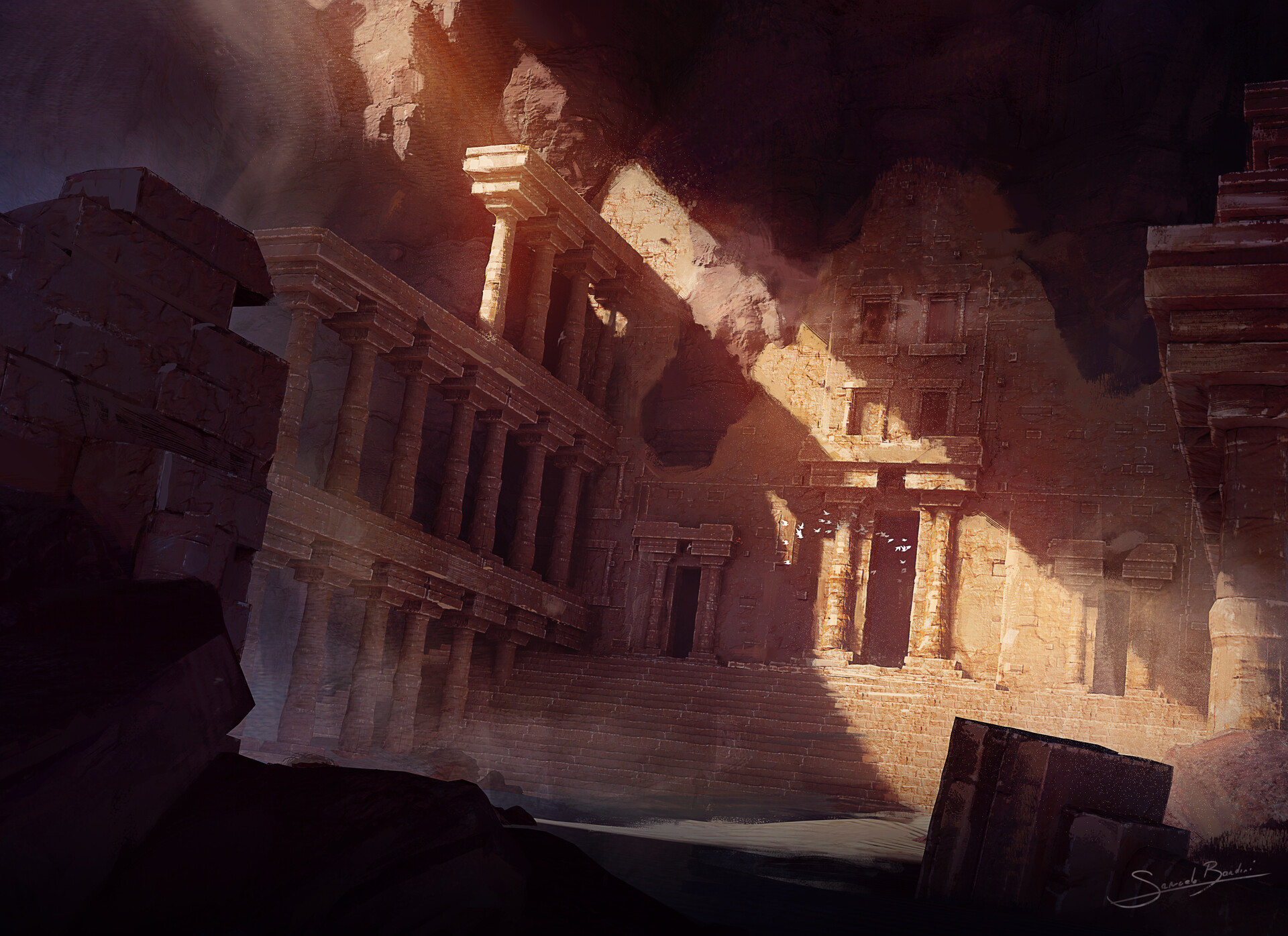
10,000 Chambers of the Cnite King

Deep within the turgid reaches of the Samarkand Desert, a lone crag of withered sandstone presents a visage long scoured by time.  Samuele B...